


Catch-up service:
Is the Current Gulf War Taking Place?
How To Build Your Own Tower
33 Things I Heard At Foo Camp
A Deep Dive Into ‘I Feel Fine’
Pitfalls of AI Journalism
Centrism’s Anger Problem
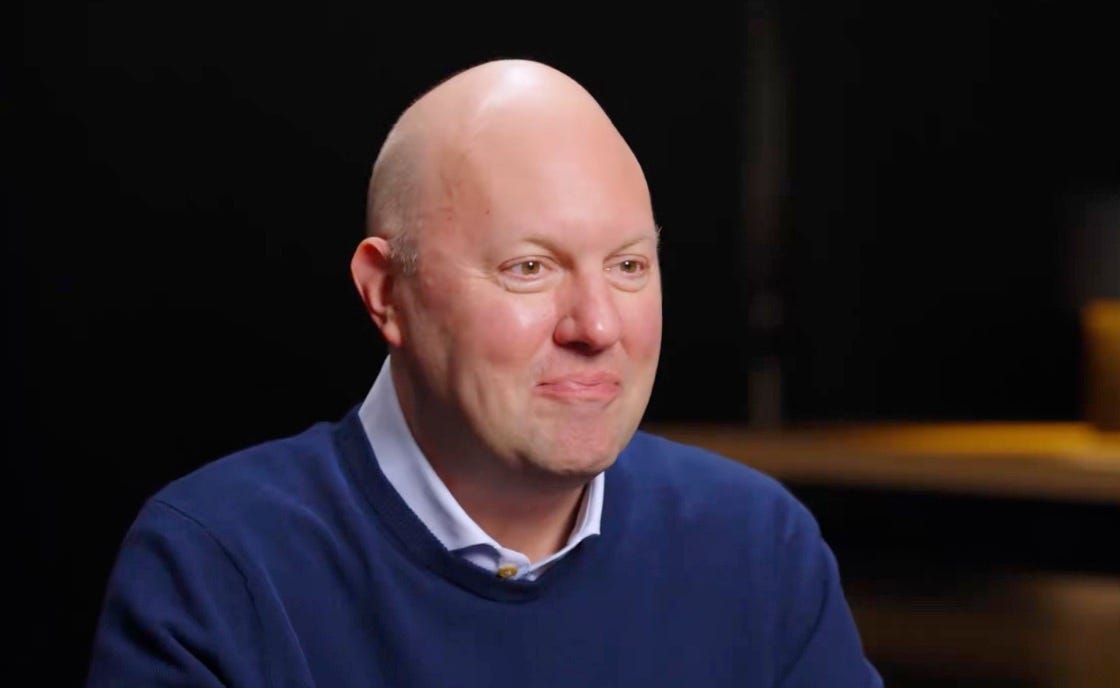
In a recent podcast interview, the Silicon Valley investor and entrepreneur Marc Andreessen claimed to have “zero” level of introspection, or at least, “as little as possible”. He also proposed a grand historical theory of introspection as a kind of life-sapping disease imported from Austria in the early twentieth century. For this he was savagely pilloried on Twitter/X, where he is something of a Main Character, with over two million followers.
That is fair enough, given that much of what he said was plain silly. It’s fun to put a billionaire in the stocks, especially one who came out for Trump in 2024 and has apparently infinite regard for his own sagacity. But actually, I think Andreessen made an interesting point here, one which got buried under the discourse avalanche. This post is an attempt to rescue it.

You can watch the relevant clip here, This is a summary: his interviewer, David Senra, asks him to elaborate on his dislike of introspection. Andreessen says: “I find people who dwell on the past get stuck in the past. It’s a problem at work and it’s a problem at home.” Senra agrees, noting that one of his observations from reading biographies of successful entrepreneurs is how little they introspected: “Sam Walton didn’t wake up thinking about his internal self. He just woke up and was like, I’m going to keep building WalMart…”
Andreessen then embarks on his drunk history riff:
“All of the modern ideas around introspection and therapy were manufactured in the 1910s and 1920s…Great men of history didn’t sit around doing that stuff at any prior point. It’s all a new construct. First, Western civilisation had to invent the concept of the individual, several hundred years ago. Then for a long time it was, the individual runs and builds things - empires, companies, technologies - and then this guilt-based whammy showed up from Europe, from Vienna, Freud and that movement - the individual needs to self-criticise, feel guilt, look backwards, dwell on the past. It never resonated with me.”
This is the section that really, uh, resonated with people. Scornful counterpoints came thick and fast. If we’re talking about great men of history, they don’t get much greater than Napoleon, who loved to dwell on his stormy emotional life, after Goethe. Benjamin Franklin was methodical about improving his own character and habits. Abraham Lincoln was beset by self-doubts and anxieties, and wrote eloquently about them. Introspection was hardly invented by Freud. Shakespeare created the most famously introspective character in literature. Seneca, Marcus Aurelius, St Augustine and Aquinas all wrote about their inner states.
And yet I think the critics overplayed their hand. Many presumed a wider definition of “great man” than the one implicit in Andreessen’s statement; he was talking about doers rather than (just) thinkers, and mostly entrepreneurs. Their definition of introspection was also too wide. Napoleon’s emotional flamboyance is not evidence of self-analysis, or self-questioning. Self-improvement, whether practiced by Franklin or Aurelius, is not the same as self-discovery. Aquinas was interested in himself only insofar as he was one instance of God’s creation, the human. None of these figures believed themselves to have an inner life that was unique and fascinating in its own right.
Second, the critics seemed to imply that prolonged, self-lacerating introspection is a permanent feature of the human condition. But it’s not. This is a big subject but in short Andreessen was right to suggest that it is a cultural invention that originated in Europe, even if he was a few hundred years and a couple of hundred miles out. Its true progenitor was Martin Luther in Wittenberg, not Freud in Vienna. It was the Protestants who popularised the idea that to be enlightened requires a relentless scouring of the inner self.
That’s not good news for Andreessen’s overall thesis, of course, since the rise of capitalist entrepreneurship went hand-in-hand with the rise of Protestantism. Introspection and the work ethic are historical twins. But I still think he and Senra were on to something. I’m often struck by how many high achievers are unencumbered by self-reflection. To take an example close to home, I’ve read or watched countless interviews with Paul McCartney, and he is at his least interesting on the topic of Paul McCartney. It isn’t that he doesn’t have a rich inner life. It’s that he puts it into his work - into the songs. His therapist is his guitar.
Top sportspeople are interested in their mental life only insofar as it affects their performance. Few of them go deeper than that (Andre Agassi being a notable exception). Introspection is positively harmful when your aim is to reach a state of flow. The same goes for successful politicians. When asked in a recent interview about how certain personal tragedies had affected his formative years, Tony Blair shrugged and said, “I don’t spend a lot of time psychoanalysing myself.”
Introspection and self-doubt are in tension with the speed at which entrepreneurs have to move. If you sat next to Bill Gates or Rupert Murdoch or Mark Zuckerberg and asked them about the wellsprings of their motivation, do you think that, even if they were being completely candid, they would have anything interesting to say? They’d much rather talk about the next project, or the next deal.
Market economies reward acting over thinking at the margin, and America has the most dynamic economy in history. In fact, Andreessen was describing a distinctively American attitude to life - a Frontier mindset. Alexis De Tocqueville observed that Americans “seldom indulge in meditation” and “entertain very little esteem for it.” He was struck by the fleetness with which they experimented and innovated, unburdened by contemplation, convention, or rules. Sarah Wyn Williams, the New Zealand-born author of Careless People (my current read) characterises the spirit of American capitalism as “forward motion without introspection”.
I often think about Tyler Cowen’s playful remark: “People in the EU are super wise. You have a meal with some sort of French person who works in Brussels—it’s very impressive. They’re cultured, they have wonderful taste, they understand all these different countries, they know something about Chinese porcelain. And if you lived in a world ruled by them, the growth rate would be negative 1%.”
More broadly, I’m also sympathetic to Andreessen’s view that introspection is a hindrance to happiness…
After the jump: the therapist who says that introspection isn’t good for us and why I’m shallow and boring. Plus a glorious Rattle Bag.
