



Catch-up service:
Anatomy of a ‘F*ck You’
Happy John and Paul Day
Notes on Acquired Taste
Notes on Cannes
Andy Burnham Is Going To Be Another Terrible Prime Minister
5 Ways Active Listening Can Backfire
Microsoft’s AI division has launched a journal that explores the intersection between AI and the humanities. The first edition of The Humanist Review has just launched. It is beautifully designed, and features contributions from illustrious contributors like Alison Gopnik, Cass Sunstein, Alain de Botton, Naomi Alderman, Nick Cave…and me. I explore the nature of AI-human collaboration, using Lennon and McCartney and other two-person teams as points of comparison.
To go out in the semi-finals against Argentina is no shame, but to go out in the manner we did was painful. The bleakly fascinating defeat suffered by England this week embodied a wider truth that I find depressing and reassuring all at once: culture goes much deeper than we imagine, and is more resistant to change than we anticipate.
We’ll get to that, but first let’s remind ourselves that it could be worse. Imagine being Brazil, who have a far greater football history than the English, having lifted the World Cup five times, and therefore further to fall. This year they exited meekly to Norway, before the quarter finals. Even worse: they used to be adored around the world for the grace and glory of their playing style (something nobody could ever say about England). This year, their football was characterless and dull. That really is unforgivable.
A viral thread on twitter argued, semi-seriously, that the fundamental reason for Brazil’s decline is the spread of Protestantism. “Brazil was better when their players were womanisers, drunkards and slightly out of shape,” it said. “In other words, when they were behaving like Catholics”. Tragically, “evangelical Protestant sterilisation has flattened their ball, ruined their samba and obliterated their swag.”
This led to a wider discussion of whether national football teams have lost touch with who they are. The World Cup used to be a clash of footballing identities: Brazilian flamboyance versus German rigour versus Dutch fluidity, and so on. Now, young talent from around the world get sucked into the big European academies and clubs before they have absorbed their home country’s culture.
Players play alongside teammates from multiple countries, trained by coaches who copy methodologies and tactics from different national leagues. The result is that national football tournaments are deracinated, more homogeneous and less meaningful. You can even make of this a metaphor (metonym?) for globalisation if you like, blaming neoliberal economics or immigration according to taste.
While it’s a plausible hypothesis, I’m not sure it reflects the tournament I’ve been watching. To me, there still seemed to be quite a lot of variety in national styles. The semi-final between Argentina and England, in particular, offered a sharp rebuke to this theory. The Argentinians proved themselves masters of what football writers call “the dark arts” (or shithousery), as they have been for the ages. They also displayed their historic ability to sleepwalk through a match until a moment of peril, at which point they snap into beast mode.
As for the England team, well, it really is deeply, indelibly English. Throughout this World Cup I feel like I’ve been watching the same team as I’ve been watching for forty years. In an England game, nothing is easy; everything is struggle. Technically skilled individuals frequently look as though they have been introduced to a football for the first time. Long stretches of mediocrity are redeemed by thrilling moments of derring-do: goals scored in fast, dagger-thrust moves; goals averted by huge men hurling their bodies into the path of the ball. As the end of the match approaches, backs are always to the wall, bodies always on the verge of collapse. Somebody bleeds manfully. Then we either pull it off in stubborn defiance of footballing gravity, or submit to a team that has somehow retained the ability to make an accurate pass.
To be a longstanding England supporter is to glimpse life inside Nietzche’s concept of eternal recurrence: “This life as you now live it and have lived it, you will have to live once more and innumerable times more; and there will be nothing new in it, but every pain and every joy and every thought and sigh and everything unutterably small or great in your life will have to return to you, all in the same succession and sequence.”
The pattern with which we’re most familiar, having seen it in tournament after tournament, is the siege defence. It’s as if our players are unconsciously drawing on collective memories of Mafeking and Dunkirk; on stories of an island people repelling invaders. The wonder is that each generation of players seems to absorb the English script and to perform it convincingly.
It goes like this. After going a goal up, England pull up the drawbridge. The players focus on repelling attacks instead of making them. They get trapped inside their own penalty area. The halfway line seems impossible to reach, let alone traverse. Now and again a defender or the goalkeeper will hoof the ball to the other end but there are no England players there and it returns within seconds. The opposition launches yet another attack. Our players look increasingly panicked and ragged. Oh that was close! Oh what a save!
Oh shit.
It was particularly dismaying this time because we thought this team had broken the repeated sequence and escaped the recurrence. It was like watching someone who has undergone an apparently successful course in cognitive behavioural therapy suddenly falling back into self-harming patterns of behaviour, formed in childhood.
It was befuddling, too, because there is no obvious reason for it. England’s stars play under sophisticated international coaches, alongside elite players from all over the world. Some play in German and Spanish leagues, for top teams. They have a German manager. The players are of diverse heritage (20 of them had the option of playing for another country). Most are too young to remember any tragic defeats from more than twenty years ago.
We have as good or better a set of players as we’ve ever had, mentally strong and technically skilled. We have one of the most successful coaches in the world - a real killer, a German of vulpine intensity and scouring intelligence with bracingly little patience for our habit of ruminating on past defeats. Whenever Tuchel was asked about the English past or the English mindset, he politely made it clear that it wasn’t his job to heal the national psyche. His only job was to win. The best way to deal with trauma was to ignore it.
But while you may not be interested in trauma, trauma is interested in you. After England went one up against Argentina, the team immediately began to sit back, apparently seized by panic about what might happen if they didn’t. Nobody made this decision. The players were not instructed to do it. It was an act of the group mind, the collective unconscious. Fear narrowed the team’s vision. The players stopped even trying to make passes to each other. Then, fatally, instead of trying to break his team’s trance, Tuchel succumbed to it. He took off attacking players and added defensive ones. Whether he meant to send a message or not, the players received one: dig in, lads! Backs to the wall!
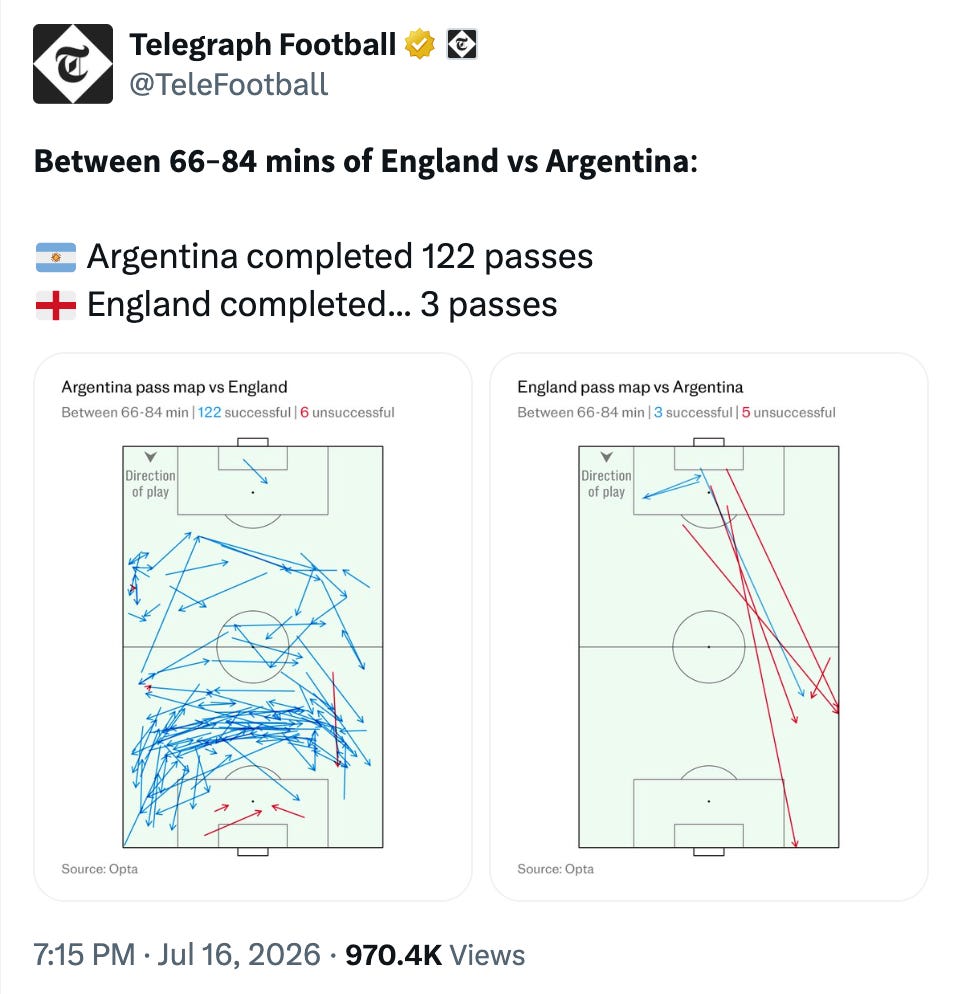
Meanwhile, Messi and his wingmen swarmed through the English ranks with ferocity and guile, untroubled by counter-attacks to test their ageing legs. Even armchair fans could see that it was only a matter of time. On Tuchel’s bench, fresh, terrifyingly fast attackers salivated at the prospect of taking on Argentina’s defenders. All tournament, Tuchel had talked up their ability to change games with speed and aggression. But they stayed on the bench. (It reminded me of Madeleine Albright’s question to Colin Powell: “What’s the point of having this superb military that you’re always talking about if we can’t use it?”.)
Culture, in the deep sense, is mysteriously powerful. It eats tactics for breakfast. Coaches too. Brazil’s exit was also overseen by a superstar club manager from another country (Carlo Ancelotti). No team managed by a foreign coach has ever won the World Cup. This year’s finalists, Spain and Argentina, are led by native coaches with no experience of managing elite clubs; coaches who would otherwise be almost completely unknown to the world. Luis de la Fuente and Lionel Scaloni have succeeded where objectively better managers have failed at least in part because they understand their national football culture from the inside out.
England’s World Cup was the story of a brilliant, rational, strong-willed outsider hopelessly overwhelmed by native forces he couldn’t comprehend. It was a story of ancestors rising from the dead to reclaim their descendants. Sure, you can cultivate your “mentality,” they seemed to whisper to this admirable, talented team. But you can’t escape who you are. You are ours. You are English.
This piece is free so please share and ‘like’ if you liked it. After the jump: a bumper Rattle Bag, featuring a great loser’s speech; a new theory of biological life; why I can’t stop watching Mick Jagger interviews; Jude Bellingham’s grandad; LLMs and creativity; and some gorgeous choral music.
The Ruffian depends on paid subscribers, I literally can't do this without you. A paid sub gets you the best of the Ruffian every week and full access to the archives. Please consider signing up today!
