


Catch-up service:
Reasonable and Unreasonable Men
In Praise of Weak Kings
America’s Still Functioning Democracy
Why I Don’t Believe In Centaurs
On the Sally Rooney Case
The Optimal Margin of Delusion
Why Is the Left So Bad at Education?I’ll be writing about You Can See Everything next week. Your homework is to watch it, so that I don’t have to worry about spoilers.
Happy Thanksgiving to our American friends from the cradle of democracy. If you’re curious to know what our political media was dominated by this week, it was this kind of thing:

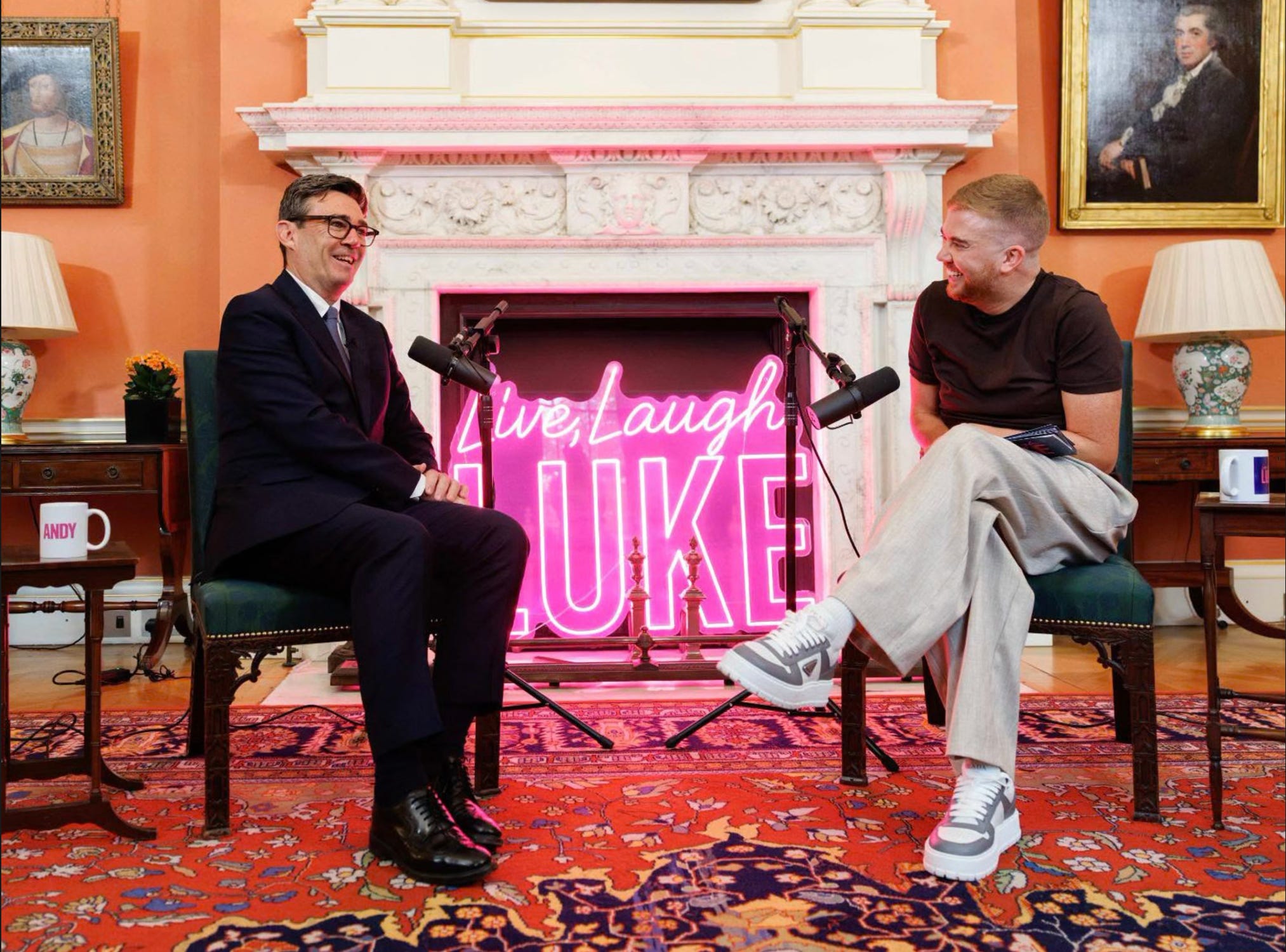
Let me explain. For a few days, the news was about our tortured relationship with the EU, but we soon got bored of that. It then emerged that the Prime Minister, Andy Burnham, had hosted a party for TikTok influencers at 10 Downing Street, and some of them had been pretty wacky characters. Here at last was something to get our teeth into.
A series of deranged clips bubbled into our feeds. One showed a chap called Luke Hamnett (“Live, Laugh, Luke”) recreating Hugh Grant’s dance down the Downing Street staircase in Love Actually. Another showed someone called Max Balegde on the steps of No.10, lip-syncing to the words, “bomboclaat pussywagon chicken nugget”. People went slightly nuts over this one, in particular. It was said these words are horribly offensive (maybe, if you try quite hard); that Balegde had made a Nazi salute (he hadn’t), and that “chicken nugget” is code for “white women” (it isn’t, not in this case anyway). Westminster was consumed by this. The Leader of the Opposition took the Prime Minister to task in the House of Commons.
Amidst the hysteria, there were serious questions. One is whether Burnham and his team shouldn’t be entertaining “content creators” at all. Influencers aren’t journalists, who ask difficult questions. They are simpering co-conspirators who giggle along with the PM while he says whatever he plans to say. Presuming Burnham only has so much time for media, choosing influencers over journalists is a neglect of democratic duty.
This charge does have something to it, even if it has mostly been made by journalists. But while Downing Street was embarrassed by these clips, it isn’t about to stop servicing the smooth-brained Eloi of TikTok. Burnham’s supporters point out that younger voters aren’t reading The Daily Telegraph or watching the News At Ten; they’re mainlining vertical video. Politicians have to go to where the voters are, and these voters are swimming in memeslop.
I suppose this is true, but still, there is something excruciatingly undignified about the whole thing. Watching the Live Laugh Luke guy prance around Downing Street in tee-shirt and trainers, or a young woman dance outside its front door to a song called ‘low budget vagina’, you wonder if there’s anything an influencer could do that might make someone on the Prime Minister’s team, or the Prime Minister, say, “Hang on. This is 10 Downing Street. This isn’t proper.”
Is it sententious to even raise such concerns? Some would say so. Patrick Maguire of The Times, for instance, said, “This idea that Number 10 is a really sacred place and we should treat it with reverence, like it’s the Hagia Sophia or Notre Dame…I mean it’s just not.” Silly things have always happened there, he continued, citing Noel Gallagher doing coke in the toilet in 1997 - although Gallagher didn’t, as far as I know, make a video of it with Tony Blair’s approval. I would like to think there is a space somewhere between sacred reverence and bomboclaat pussywagon.
Nobody likes standing up for decorum because it’s fundamentally uncool, and for middle-aged politicians, to be seen as uncool is a terrifying prospect. That’s why, as Helen Lewis says, they “act like the supply teacher who wants to be friends with you, or Amy Poehler’s character in Mean Girls…”. But protocol and formality are among the ways we imbue institutions with prestige, essential to the peaceful functioning of democracy. Strip away the aura of authority and you’re left with coercion.
Contrary to global rumour, Britain is not a particularly pompous country. The fact that our leaders live and work in a terraced house on a side street tells you that we are constitutionally suspicious of self-important politicians. Our Prime Minister starts work the day after a general election, and somehow manages without an “inaugural ceremony”. (Unlike republics, we reserve our pomp and ceremony for the least powerful institution of the state.) Still, the centre of power in a democracy should feel like a special place. Not a palace or a church perhaps, but a serious house.
Politicians fret about voters thinking they’re aloof or out of touch, when they should worry more about the loss of seriousness. Maintaining it starts with believing in it; if they don’t take themselves seriously, nobody else will. This isn’t just a challenge for politicians, it goes for elites across the board. The Church of England is notorious for its self-harming lunges at relevance. The Dean of Canterbury recently invited local artists to daub the cathedral with graffiti. Chelmsford cathedral has hosted a “90s silent disco” (it is silent, I suppose).
The cultural sector seems to have completely lost the ability to be serious. Birmingham Museum has hidden its fine collection of art and ceramics and replaced them with a series of jokey exhibits, like the A to Z of Birmingham (B is for Balti, Y is for “Yes Bab”). The new London Museum is so worried about being seen as an actual museum that it has made itself into a fancy conference space with historical artefacts relegated to a basement area called, unbelievably, Past Time. The museum’s logo is a pigeon taking a dump.
Modern society, and our media ecosystem in particular, pushes towards ever-greater informality, casualness, spontaneity. Elites feel compelled to go with the flow. But if you want to see where trashing your own prestige ends up then you need only take a scroll through the social media feed of the American president. Recent posts include Jensen Huang waving a red bra and an AI video of the president wrestling a lion. I’m sure it “cuts through” and “reaches audiences”. But it comes at a cost - not just to this president, but to the office he holds.
When the custodians of institutions allow them to be treated as mere content fodder, they not only undermine respect for them, they drain them of meaning. At some point, the corridors of power won’t even make for good content. The fact that influencers are so eager to video themselves on the steps of Number 10 suggests it does still have some juice, but it won’t for long. When you’re irreverent about everything, irreverence itself gets boring. Swipe.
After the jump: a slightly Christmas-flavoured Rattle Bag. Are creative people more likely to be mad? Are mentally ill people more likely to protest? Plus the best songs ever; the best Christmas gift list; the best rock star interviewee; reading suggestions for the holidays; my thoughts on Fjord, and more…Please consider a paid subscription. It makes a great gift to yourself. Or someone you love, or have mixed feelings about.
