

Catch-up service:
The Stamina Gap
Has Paul McCartney Read My Book?
Best of The Ruffian 2025
How The Mad Men Lost The Plot Again
How To Do Politics When Nobody Knows Anything
When The Mind Outlasts the Brain
My Ten Favourite Books of the Year
I’ll be talking John & Paul with Helen Lewis at Union Chapel, London, on February 12. Book your tickets now! The glorious paperback edition of John & Paul is now available for pre-order.
This time a year ago I wrote about how I use ChatGPT and Claude. It’s time for an update. That post included a list of mundane tasks along with a few principles I’d learnt for getting the best out of it. Since then millions more people have started using these apps and we’re all learning more about how and how not to use them.
We learn from both direct experience and observation. People are often not very transparent about how they incorporate AI into their work. As with plastic surgery, we tend to notice the botched efforts more than the successful ones. It’s been funny to watch these bloopers come in, as they do with increasing frequency. Mayor Brabin’s fantasy map, above, is from a few days ago. Earlier this week, a senior British police chief was forced to admit that he took a controversial decision based partly on fabricated evidence dreamed up by Microsoft Copilot. Last month, McDonald’s had to pull an AI-generated ad because it was so creepy.
I offer this advice partly so that you can avoid such embarrassment but mainly to help you get more out of the technology while offering a commentary on its strengths and flaws. Here are three big “Don’ts” which together form a mini-exploration of what LLMs seems to be good and bad at for people like me who use it for non-technical tasks. After that, I have some great tips gathered from readers, who answered a call on the networks.
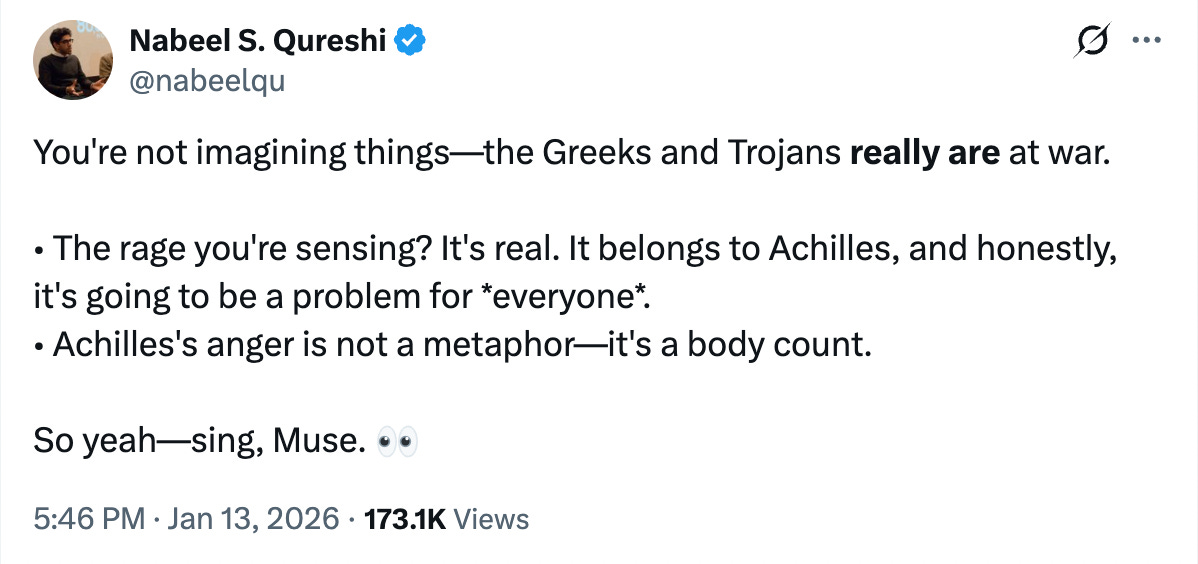
Don’t use it to write for you. It is unfair to pick this example just because it popped up in my LinkedIn feed the other day, but I now see so many posts written like this:

Staccato sentences. Hysterical metaphors. This isn’t X—it’s Y. Let that sink in. These and other of AI’s stylistic markers are not in themselves the worst thing in the world but there are two fundamental problems with them. One is that they advertise the author’s use of AI. You might ask why that’s a problem, since we all use some kind of technology to write. But if your aim is to show people that you’re a smart or interesting thinker - which I presume is the aim of most people on LinkedIn, and most writers to some extent - then you probably want readers to feel that these are your words, and your thoughts. And for better or worse people have an instinctive aversion to signs of artificiality in human communication, just we do to over-filled lips and frozen foreheads. That reaction might fade over time as we all become physical-cognitive cyborgs who look and sound identical but for now it still applies.
The second problem is that these quirks have become clichés already. Clichés are themselves are a form of artificiality, the original slop. They mark the absence of the writer’s mind. So a cliché that’s obviously from an AI is a kind of double absence. Your job as a writer, even of social media posts, is to sound as present as possible in every sentence. That becomes more important, and more valuable, the more that your peers rely on AI. People are now starting to write and talk like AIs spontaneously; the singularity is already happening at the level of language.
I don’t use AI to generate drafts. That practice seems self-defeating to me, since the drafting of a thought is the thinking of it (I wish this weren’t true, I resent it, I can’t fight it). You can give it a detailed prompt with your initial thoughts and ideas in it, but the resulting draft will still come out emptier, less you, than it would if written from scratch. Maybe you believe you can make it your own in the editing process, but I find that once a draft is generated it just kind of squats there in front of me, blotting out my own words. Its oily tone is very difficult to eradicate, like rising damp.
Oh before we move on, here’s Nabeel’s AI-generated Homer (so I guess this is a human faking ChatGPT faking a human?):