


Catch-up service:
33 Things I Heard At Foo Camp
A Deep Dive Into ‘I Feel Fine’
Pitfalls of AI Journalism
Bodies Behaving Badly
Centrism’s Anger Problem
All Hail the Putter-Togetherers
John &Paul is at number one on the Sunday Times bestseller list for a THIRD week running. Hurrah.
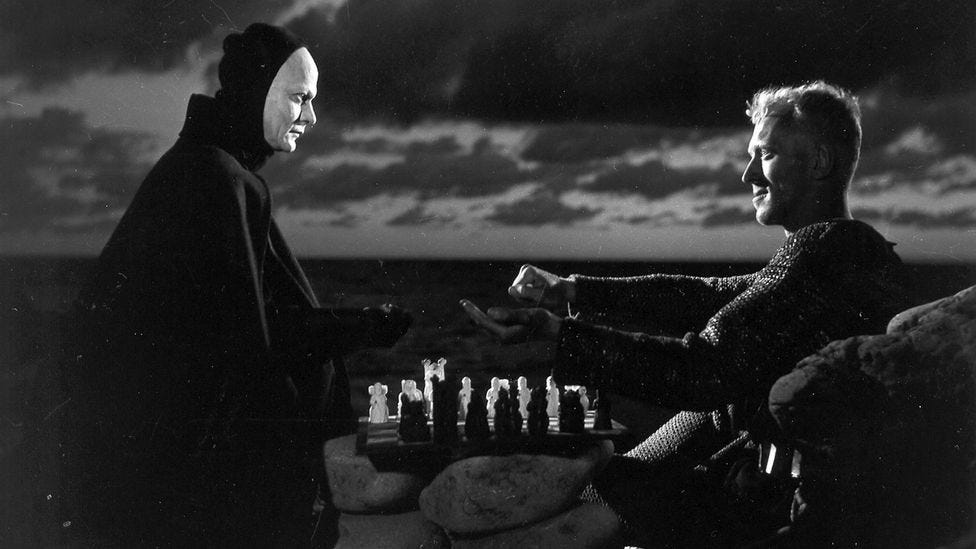
Ingmar Bergman, the great Swedish filmmaker, wrote in a workbook for three hours every morning, a rigorous version of the practice that is now called “morning pages”. He started at 9am, and finished when his clock struck for midday, even if he was midsentence.
His workbook was a freeform diary in which he wrote down every thought, feeling or experience, no matter how trivial or dark or socially embarrassing. The point was to be utterly free. Since some of his workbooks have been published, we can see that ideas for films, or scenes from films, often germinated in these sessions.
Here’s part of an entry from July 4, 1976, on a day when he was worrying about a film he wanted to make:
I think it’s the form that worries me the most. I can’t find the form, it’s not coming to me on its own. Or rather it is, but I find it tedious and uninteresting. And I’ve no inclination to write it down like that. I wish I could just skip all the mediation, all the practical circumstances and transitional phases.
My little grandson Lukas, whom I didn’t know, drowned yesterday. He was only four years old.
A small bird, greenish gray in colour, flew into my windowpane and broke its neck.
I sit in my tower and life goes on outside.
The shocking parenthesis in which he reports the death of his four-year-old grandson was not an aberration. Karl Ove Knausgaard, in his essay on the workbooks, describes Bergman as an introvert with “an almost pathological lack of empathy”. We’ll get back to that, but for now it’s the last line of Bergman’s entry I want to draw your attention to. I think we can all learn something from him about towers.
Anyone engaged in a creative project - and I use the term loosely enough to encompass, say, a Substack newsletter - needs to be able to be both open to the world and its stimulations, and able to isolate themselves from them. In fact this doesn’t only apply to creative work. I started writing this post when reflecting on how to cope with the alarming news which blares out of our screens every minute.
We used to live in a world where the news came on the hour or in the morning paper. Now, like everything else, it’s a firehose that never stops. You can cut yourself from news altogether (a perfectly reasonable option) or you can choose to remain open to it. But if you do the latter you still have to find a way to retreat from it now and again. Otherwise you just get stuck inside an information regimen which you don’t control, losing all distance and perspective.
That isn’t healthy. It doesn’t do any good to be worrying about things over which you have no control and only superficial knowledge. I’m fond of the philosopher Michael Oakeshott’s response to the young Andrew Sullivan, when the latter told him he wanted to be a journalist: "I consider the need to know the news every day a form of mental disorder." Oakeshott no doubt appreciated Schopenhauer’s dictum: “The art of not reading is a very important one. It consists in not taking an interest in whatever may be engaging the attention of the general public at any particular time.”
To get distance and perspective on the world you need a tower.
