


Catch-up service:
How To Build Your Own Tower
33 Things I Heard At Foo Camp
A Deep Dive Into ‘I Feel Fine’
Pitfalls of AI Journalism
Centrism’s Anger Problem
All Hail the Putter-Togetherers
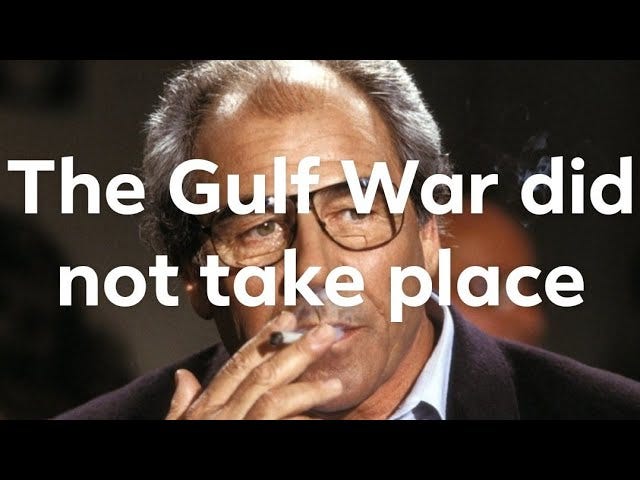
In 1995, Jean Baudrillard, French philosopher and apostle of post-modernism, published a book called The Gulf War Did Not Take Place. It consisted of three essays he wrote for the French newspaper Libération in 1991, while the Gulf war was, in fact, taking place.
A brief recap: what we now call the first Gulf War was provoked by Saddam Hussein’s invasion of Kuwait. The first President Bush assembled a coalition of allies (including the Soviet Union) to put economic and diplomatic pressure on Saddam. When that didn’t work, he sent in troops and missiles. America drove the Iraqis out of Kuwait. Bush chose not to force Hussein out. The rest is people saying “the rest is history”.
I remember the day the war started. Here in London there was a sense of foreboding, of terrible forces being unleashed, even if the action seemed legitimate and necessary. I don’t feel that there was quite the same moment here when Trump announced the beginning of “major combat operations” in Iran. Perhaps that’s because it isn’t a land war with troops and tanks rolling into battle. But it’s also to do with the suddenness of the event, the confusion over why it’s happening, and the way that the current US president imposes his own sense of dizzy unreality on all of us.
As a leader, Bush Sr. was more or less the opposite of Trump - slow, cautious, painstaking. When he said that America would draw a line in the sand, the world could be fairly sure that he would follow through.1 With Trump, you never know what’s going to happen next, or indeed what just happened. At the start of the year he launched a strike on Venezuela with even less warning. So the attack on Iran seemed less like a discrete and momentous event and more like the latest video in a never-ending doom-scroll.
This is why people have been raising the name of Baudrillard, who died in 2007. When his book on the Gulf war was published in English it met with howls of derision and moral outrage. If Twitter had been around, he would have been cancelled. The influence of post-modernists in the academy seemed to be at its height (in retrospect, it was just the beginning) and his book was a flashpoint in the battle between doughty Anglo defenders of reality and feckless French philosophers who denied there was any such thing.
To some extent, the moralising was justified. Real people were being killed by real bombs in the Middle East, as Baudrillard wrote his think-pieces from the safety of Paris. But if the title of his book was hyperbolic, his actual argument was a bit more nuanced. Baudrillard wasn’t claiming that no military action had taken place in the Middle East, but that the war’s true raison d’etre was spectacle. Its violence and casualties were fodder for what today we’d call a reality television show, created and produced by the American government. It was content.
In his view, the television narrative of reality was now shaping reality itself. America wanted a new show and it got one. Not because cynical politicians were manipulating a duped public, but because everyone, politicians and generals included, was lost inside the simulation. The spectacle had swallowed the real.
I should say, I don’t believe he was right about that war. His explanation for it seems superfluous. There were obvious reasons, economic and geopolitical, for America not to allow Saddam Hussein to colonise Kuwait. Bush, whatever his flaws, was a serious statesman, with a formidable foreign policy team. This was not an administration which went to war for the pictures.2
But perhaps Baudrillard was simply ahead of his time. His argument applies with more force to the current Gulf war, and the current moment.
