


Catch-up service:
How Evil Is Mark Zuckerberg?
Giving Advice Is a Treacherous Business
Against Introspection
Is the Current Gulf War Taking Place?
How To Build Your Own Tower
33 Things I Heard At Foo Camp
A Deep Dive Into ‘I Feel Fine’
This piece is free to read. It’s followed, for paid subscribers, by a gloriously bulging Rattle Bag (making up for the one skipped last week).
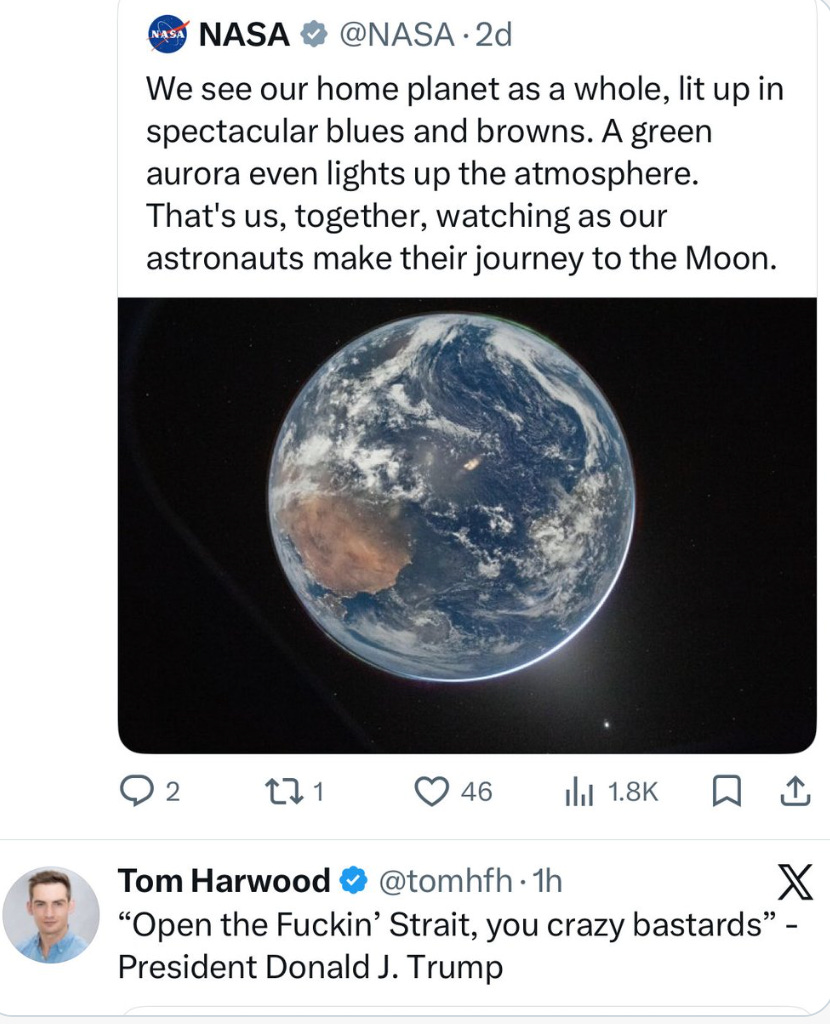
I am grateful to NASA and the astronauts of Artemis II for providing a shaft of light in the darkness. The two biggest news stories this week have been a joyful voyage around the moon and a senseless war in the Gulf. It’s like a rather heavy-handed parable of humans at their best and worst. My feed was simultaneously full of the ravings of an actual lunatic who is somehow the most powerful person on earth, and a chorus of delight at the stunning pictures beamed in from space. Sometimes, the juxtaposition verged on comic:
The Artemis II story defied the timeline in a deeper sense. It feels as if it was dropped into the news from a bygone era; a benign ghost sent to remind us of how we used to feel about the future. It is a story about technology that empowers humans rather than threatening us with obsoletion; a story about what we have in common rather than what drives us apart; a story of American heroism. It couldn’t be more retro. You could call it a Generation X moment. All four members of the crew are aged between 47 and 50, which means that, like me, they grew up with a sense that that the world is getting better, people are basically good, technology is on our side, and progress is inevitable.
It helps that these individuals are so attractive and likeable (like all members of Gen X). They are not grifters using this as a stepping stone to wealth and influence, but true believers; the name of their craft, Integrity, does not seem like a bitter joke. Each of them travelled a long way to get to the launchpad, with setbacks and tragedies along the way. That they include a woman and a black man does not seem tokenistic but merely apt. I know there are conspiracy theorists who believe the whole thing is fake, and I’m sure there are culture warriors who hate it, but for most people, Artemis II is a chance to take a breather from all that and remind ourselves of what humans can do when they’re not at each other’s throats.
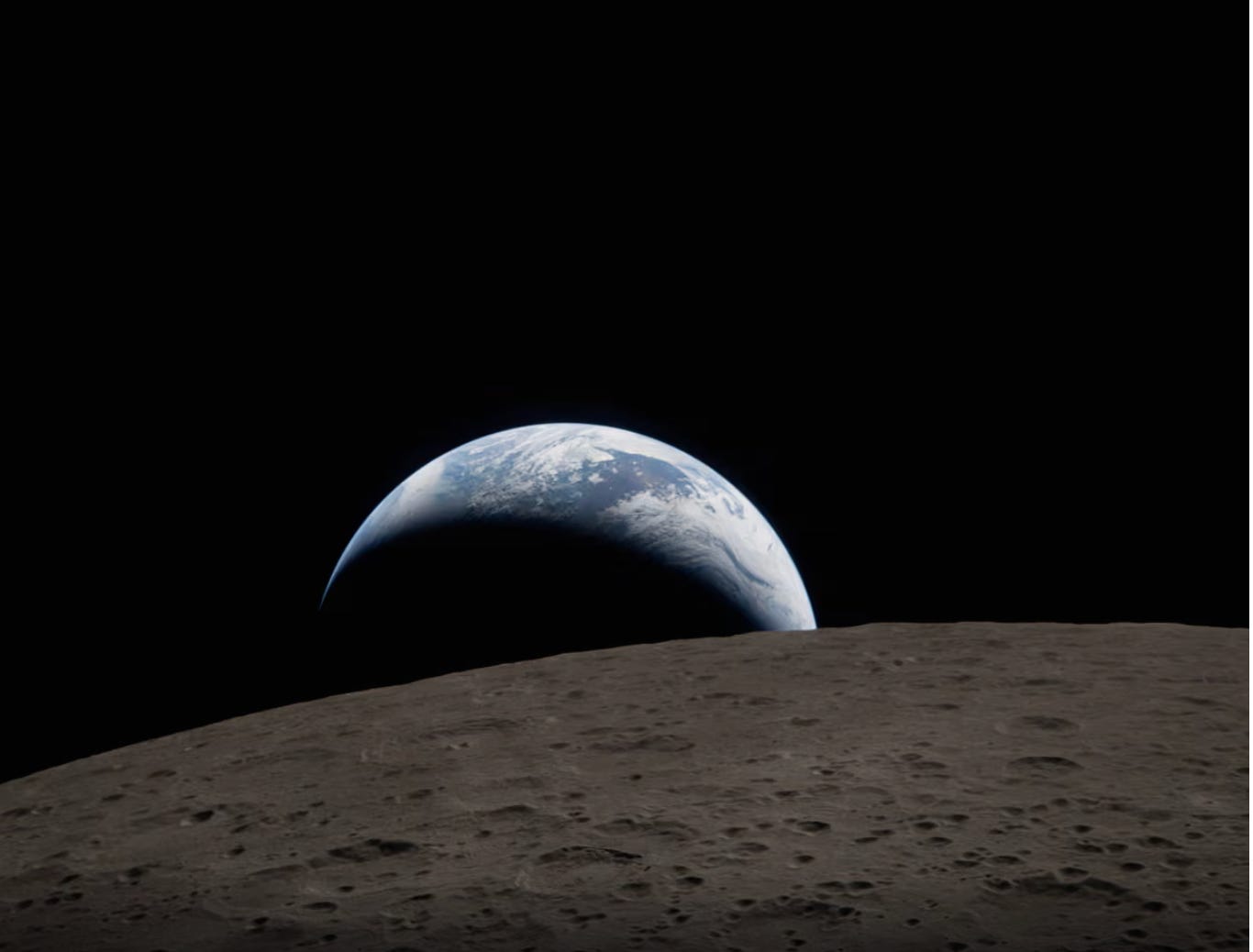
Above all, it is the pictures which amaze us; which provide us with a visceral insight into how vast and strange the universe is, how much there is to explore, and how dependent we are on the Earth’s atmosphere to protect us from the engulfing emptiness. The people with the most intense experience of this insight are, of course, the astronauts themselves. We are seeing our world through their eyes. Their training included photography, they are very aware of their role as narrators as well as pilots.
They are very good at it. Integrity crew member Victor Glover delivered a beautiful impromptu Easter message:
“In all of this emptiness—this is a whole bunch of nothing, this thing we call the universe—you have this oasis, this beautiful place that we get to exist together. I think as we go into Easter Sunday, thinking about all the cultures all around the world, whether you celebrate it or not, whether you believe in God or not, this is an opportunity for us to remember where we are, who we are, and that we are the same thing, and that we’ve gotta get through this together.”
Although Glover’s speech was heartfelt and moving, the content of his speech was familiar. Astronauts who have seen the face of the earth often respond in the same way. Here is Marc Garneau, the first Canadian in space, speaking from aboard the Space Shuttle Challenger in 1984:
“Looking down at Earth. It’s very, very beautiful. There are wars going on, there’s pollution down there, but these are not visible from up above. It just looks like a very beautiful planet, particularly when you see it interface along the edge with space. There you suddenly get the feeling that, ‘Hey, this is just one small planet which is lost in the middle of space.’”
Here’s Albert Sacco, recalling his experience aboard the Space Shuttle Columbia, in 1995:
”Once you get into space, I tell them about something I call ‘The Astronaut’s Secret.’ It’s a realization all of the astronauts have, which is that we are a member of the whole human family. It goes beyond being a citizen of the Earth—you are really a citizen of the universe. When you are in orbit, you ask yourself, ‘Why do people have the differences that they have down on Earth?’ You see that Earth is just a small part of a large universe, and you have a feeling about it that is hard to describe.”
These themes recur over and again in astronaut testimonies: a sense of the smallness, beauty and vulnerability of our planet, combined with a conviction that humans must transcend their petty differences and recognise the essential unity of our species.
In fact this response is so common that it has been given a sciencey-sounding name: “the overview effect”. The term was coined by American writer Frank White in his 1987 book, The Overview Effect: Space Exploration and Human Evolution. White interviewed 22 people who had been to space, identified these recurring themes, and concluded that seeing the Earth from space triggers a shift in awareness which fundamentally changes people for the better.
He crafted a grand narrative out of his materials. For White, the overview effect represents an evolutionary step change, latent in humans since the birth of the species. Space flight, he said, is aligned with the “general purpose” of mankind. It represented hope for the future; a chance to leave behind nation states and petty territorial disputes forever. He proposed that his readers become “terranauts”: evangelists for space science and technology, who will usher in the next stage of humanity’s evolution.
Despite being full of junk history and dubious science, White’s book and his big idea proved remarkably popular, especially among elites. The overview effect was enthusiastically endorsed by environmentalists, peace activists, space industry advocates, and politicians. In 1997, President Bill Clinton cited it in a speech at a White House conference on climate change. It has been studied by psychologists and integrated into the research and development of space technology, including spacecraft design. In 2008, White founded The Overview Institute in Washington, DC.
Not everyone is aboard this ship, however. In 2014, a historian of science called Jordan Bimm published a waspish critique of the overview effect. He argued that rather than being a neurological phenomenon it is an artefact of America’s Cold War ideology. Bimm’s approach reminds me a little of Roland Barthes in Mythologies. Barthes examined a series of cultural stories and images which presented themselves as natural and universal, like the unifying goodness of wine in France. Using semiotics - the study of cultural codes - Barthes showed how these myths served particular political interests at particular moments. Scratch “nature” and you get history.
Bimm traces the overview effect’s provenance to those iconic photographs of the Earth which emerged from the moon missions - in particular, “The Blue Marble”, taken from Apollo 17 in 1972, which became perhaps the most reproduced image in history.1 In the 1970s and 1980s, it suited America to present its bid for global hegemony as a story of universal peace and harmony. Space exploration was a convenient means to embody and burnish this story - it was “manifest destiny” on a cosmological scale. The Russians or Chinese or Indians may not have been quite so moved by the astronauts’ rhetoric of universal human love.
It’s not that the astronauts were being consciously propagandistic, it’s that they knew the right thing to say. Bimm points out that it is not inevitable that humans respond positively to seeing the Earth from space, as White suggests. Test pilots and astronauts take part in an intense competition to be selected for missions, aware that every aspect of their performance and personality is being scrutinised. Consequently, they feel under pressure to exhibit pristine mental health, which translates as endless positivity. As a former NASA psychologist put it, “The expression of emotions such as sadness or fear is considered a weakness. The pilot/astronaut culture is overtly hostile to the expression of such problems—in themselves and others.”
You have to go back to the early days of high-altitude flight, before such norms were fully established, to find more negative self-reports. In 1956, aviation experts identified the “break-off effect” among pilots, defined as “a feeling of physical separation from the Earth when piloting an aircraft at high altitude.” Pilots spoke about feelings of isolation and loneliness, and of losing their connection with the world - something like the opposite of the overview effect. Bimm’s point is not that all astronauts secretly feel this; it’s that astronauts probably respond to space flight in a variety of different ways.2 But in order to claim that his sample of twenty or so individuals revealed a universal human truth, White had to exclude any negative experiences.
Frank White was influenced by James Lovelock’s Gaia hypothesis, that the Earth is one giant superorganism. That idea, which dates to 1974, originated in work Lovelock did for NASA on developing a method for detecting life on Mars. Bimm treats Gaia as a cultural artefact too, another response to a historical moment in which the promise of technological progress mingled with fears about communism, over-population, and pollution.
Although Bimm doesn’t discuss this, the cultural meme most obviously intertwined with the overview effect is the one we might loosely term “liberal globalism”: the idea that the world is moving gradually towards a consensus based on markets, democracy, international law, and social tolerance. That narrative reached its apogee in the 1990s and early 2000s and is closely associated with Bill Clinton, the early years of the internet, and America’s economic and military dominance. Fukuyama’s “end of history” (at least in its popular form) is a sibling of White’s idea. For White’s terranauts, read Ivy League liberals who saw themselves as the stewards of this inevitable progress.
If this makes me sound cynical about this mission or these astronauts or any of those who have slipped the surly bonds, then it’s not meant to, because I’m not. I appreciate Bimm’s clear-eyed interrogation of White’s myth, but as myths go, I rather like this one. I’ll take it. A story about universality and co-dependence is preferable to the brutal zero-sum rhetoric that dominates political discourse today. That the overview effect isn’t scientific or ‘natural’ doesn’t make it meaningless. It might be a fiction but fictions can harbour important truths.
The rationale for Artemis II is also a kind of fiction. NASA’s story is that this is a step towards building a lunar base, which might help us get to Mars one day. We all know it’s not really about that. They’re lassoing the moon because they can, and the rest of us are thankful for the sublime spectacle of them doing so. Take a moment to enjoy Reid Wiseman’s pure, childlike, unfakeable excitement at seeing the moon up close, punctuated by the chuckling delight of his counterpart at mission control (“Copy, moon joy”). It’s enough to make a terranaut out of anyone.
This is free to read so please share and ‘like’ it, if you liked. After the jump: a very juicy Rattle Bag, full of important stories and fascinating insights you may have missed…
