


Catch-up service:
Notes on Cannes
Andy Burnham Is Going To Be Another Terrible Prime Minister
Podcast: Benedict Evans on AI and Jobs
5 Ways Active Listening Can Backfire
The Petty Status-Seeking of Great Geniuses
Labour Isn’t Thinking
All the Photos I Couldn’t Use For John & Paul
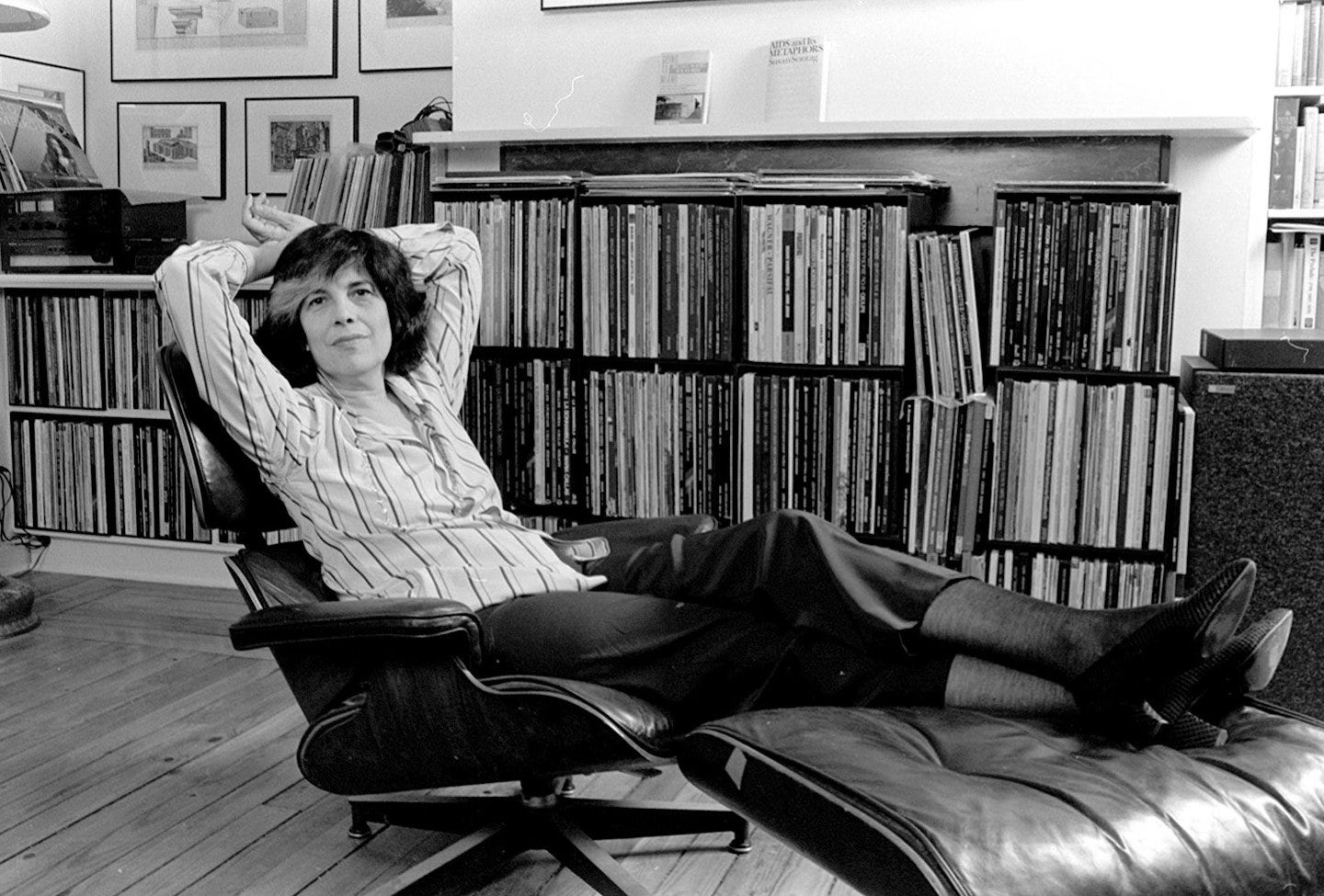
In Susan Sontag’s Notes on '“Camp” (1964) she writes (with, I think, a hint of camp):
“…these are grave matters. Most people think of sensibility or taste as the realm of purely subjective preferences [or] attractions…But this attitude is naïve. And even worse. To patronise the faculty of taste is to patronise oneself. For taste governs every free—as opposed to rote—human response. Nothing is more decisive.” (My emphasis).Sontag has an expansive concept of ‘taste’. She talks of taste in people, pictures, emotion, actions, morality. Even intelligence, she says, is “a kind of taste - taste in ideas”. I’m not certain how useful it is to stretch the concept this far - so far that it colonises intelligence and judgement and wisdom - but Sontag’s high regard for taste, her declaration of its central importance, feels very timely in 2026.
It has become almost a cliché to name “taste” as one of the last human advantages over the machines. AI is acquiring the skills to make slickly produced pictures and songs and books. But it isn’t yet very good at distinguishing the brilliant from the mediocre; the just right from the just OK.
It models what we like, which makes it hard to see how taste might change. Ask it to generate twenty songs or twenty jokes and pick the best, and it will pick the one that most closely resembles what the median person would deem good. It won’t pick the surprising, odd one - the one that is ‘wrong’ in a suggestive way. But that’s where the good ideas come from. Innovative culture emerges, like new species, from mutation; from interesting accidents that open up new possibilities.
It’s not as if humans don’t ‘model’ what came before them, often quite algorithmically. We have traditions, genres, chains of influence. We have plenty of human-made mediocrity - more than ever, thanks to our new assistants. But we also have an ability to adapt or reinvent the model; to put it to our own purposes.
Individual artists do this intuitively and almost randomly in the process of making. Writers learn to write (painters learn to paint etc) by imitating their predecessors. They learn to be original by getting the imitation wrong and noticing that they like the error. This is an act of taste; the free human response.
When he was stuck on a painting, Francis Bacon would throw a glob of paint at his canvas then work out how to incorporate the result. Artists make decisions and then try to understand why they might have made them. It’s the dialogue between gut and head that produces the work.
Taste is similarly post-rationalised, or back-propagated. You notice what you like or dislike and extract a rule from your response. Do this enough times and you build a powerful discrimination engine.
You also get good at knowing what goes with what. You learn to recognise the clichés of the category, which means you know how to subvert or overturn them. That’s why great artists are such voracious consumers of work from within and beyond their own field. Martin Scorsese has watched at least one film every night for most of his adult life. He watches and records and re-watches obsessively. When he donated his collection of VHS tapes to a university it consisted of 4,400 films, documentaries and TV shows.
It’s more than pattern recognition. The machines are pretty good at that, after all. Taste is connected to that other human moat - to our sense of purpose, of why we’re doing this in the first place. We’re still the ones who write the prompt - who decide what to create and what is beautiful, important, and valuable. The machine merely knows how to execute on our preferences.
It can model what we already like with astonishing facility but it can’t give us the next Shakespeare, or the next romanticism or modernism or punk or hip-hop. These new forms aren’t just statistical recombinations. They are born from anxiety, rage, envy, pain, ambition. How do you respond to the unprecedented mass violence and human waste of the Great War? Not by following pre-war cultural conventions.
New movements are also born from scenes - from humans in proximity to each other, everyone desiring this man’s art and that woman’s scope; ideas, emotions and bodies colliding.
These movements create the taste by which they’re consumed. “Impressionism” was a derisive nickname for paintings that most art lovers considered weird and sketchy. But the art was good enough to bend popular taste around it. Even more obviously difficult art, like Rothko or Pollock, now has an audience of millions. Some of those people like it immediately; others have acquired a taste for it.
I’m fascinated by the notion of acquired taste. Strictly speaking, it’s a redundancy. Nearly all tastes are acquired. Nobody is born with particular tastes in design or architecture. We gain a sense of what we like, or what we consider to be good, from our peers and predecessors.
But acquired taste does refer to a distinct phenomenon: the act of willing a preference into being. You didn’t like whisky the first time you drank it, but perhaps because your father liked it or because you were aware of its cultural prestige, you tried it again and again, striving to appreciate it. Then one day you didn’t have to try anymore. You just liked it.
This writer likens it to a magic eye picture: you stare at it for ages without seeing what you’re told is there, and then suddenly - there it is.
This is very different to stumbling upon something we immediately like, which is sometimes referred to as ‘discovered taste’. (Edmund Burke called it ‘natural relish’.) That kind of liking involves no work, no friction, no overcoming of resistance.
Some cultural objects lend themselves to discovered taste, others don’t. I can’t imagine anyone needing to acquire a taste for Ella Fitzgerald’s voice, but there are other great vocalists whose voices you must learn to like. The most frequently cited reason for not liking Bob Dylan is antipathy to his voice. But if you learn to appreciate the many incredible things he does with it, you will end up in a more intense relationship with it than with the voice of a more obviously palatable singer. Once you’re in on an acquired taste, you’re all in.
The same is true of whole genres. There are many pieces of classical music that are easy to like. You don’t have to listen to Mozart’s clarinet concerto more than once to be seduced by it. But as a whole and on average, it’s a genre that requires more effort to appreciate than pop. Once you find the key to its heavy oak door a vast and fabulous kingdom awaits. Your memory of the effort it took you to get there, and your awareness of all the people still outside the city walls enhance your appreciation. (That doesn’t mean you want people to remain outside - quite the opposite).
Difficulty doesn’t make the cultural object concerned better or worse than one that’s immediately likeable. But it does usually mean it’s more complex, and complexity is correlated, loosely and unreliably, with quality. Acquired taste involves the appreciation of subtle properties that don’t make themselves known on first listen or view or read.
Without appreciating what lies on the other side of the door, why do we ever make the effort to unlock it? Partly because we want what other people want. We might trust the taste of our father or girlfriend or teacher. Perhaps we want to please them, impress them, or feel closer to them. Perhaps we want the social cachet that goes along with this particular taste. To my mind, all of these reasons are perfectly good ones. If a taste is truly worth acquiring, any motivation will do.
It’s often seen as slightly embarrassing or shameful to acquire a taste through conscious effort. It’s for the try-hards and the social climbers. Liberal societies value spontaneity in taste. “Like what you like, love what you love!” Your gut response is meant to be the authentic one, the one that represents “the real you”. To be swayed by social pressure or by experts and reading is regarded as a sign of insecurity or pretentiousness. But let yourself believe that and your tastes will be less likely to evolve and expand and you’ll miss out on a lot of great stuff. Many of the greatest, most compelling and satisfying cultural objects are complex, occluded, spiky, difficult to like. (Some of the best people too).
Believing a cultural object to be good and valuable, but not liking it, is a kind of failure. For me, it’s quite common. I usually want to try again, to look for some other way in. That often comes from someone whose taste I trust, a friend or a critic. I am very pervious to enthusiasm.
This decoupling of ‘what is good’ from ‘what I like’ may be less common than it was. There was lots of debate about what should have been on the Guardian’s Best 100 Novels list but to me the premise itself was confused. Neither judges nor readers seemed to make much distinction between the novels they liked best and the novels which are the best. Those ought to be two separate categories.
The sociologist Jon Elster pointed out that we automatically adapt our preferences according to what’s available. That’s what the fable of sour grapes is about - the fox decides the grapes he cannot reach are bad grapes anyway. Most of the time this happens beneath conscious awareness; there’s an element of self-delusion to it. Elster therefore puts a higher value on conscious preference adaptation, because that involves human autonomy - the freely made choice. Acquiring a taste is part of what he calls ‘character planning’ - consciously designing the kind of person you want to be.
You might argue that aspiring to like something because you’ve been told it’s good is hardly an autonomous act, but it is, as long as you have good reason to trust whatever the cultural authority you’re relying on, and as long as you ask your own questions of it during the engagement. It’s just a way of deciding where to allocate your time and effort, rather than letting the moment or the market decide for you.
That’s why I still value distinctions of ‘high’ and ‘low’ culture. It is good that classical music and theatre and fine art retain an aura of social desirability. Yes, this prestige can shade into fakery and snobbery and exclusivity, but if the high arts lose their aura altogether - and they have been losing it - the result won’t be some wonderful democratic expansion of appreciation, but obsoletion. In a raw battle for liking, there are simply too many cultural products with lower barriers to entry, even if they are ultimately less satisfying. The high arts depend on social prestige to gain the space and time they need for consumers to acquire a taste for them.
I am not dismissing the value of discovered taste - the stuff we find ourselves liking without effort. As the aesthetic philosopher Kevin Melchionne puts it: “No matter how refined the taste I acquire, a personal canon dominated by acquired taste and relatively devoid of discovered preferences will lack the joy and excitement of personal discovery.” We should aim for a diverse portfolio of acquired and discovered tastes. But the reason I value acquired taste is that it’s a manifestation of individual agency in a tech-dominated world that is constantly tempting us to surrender it.
Trying to close the gap between the person you are and the person you want to be is often called ‘pretension’. Pretending to like something is fine if it transforms into authentic appreciation over time, as it often does.
The other reason we make the effort to unlock the door is more intrinsic. It’s curiosity. Even if you don’t ‘get’ a painting or an album on first or second listen, you may get a signal that says, “persevere”. You may sense that it’s worth staying with, and that the rewards will come. Many great novels are like this - they create the reader’s taste for them, teaching you to appreciate them as you go.
This intrinsic motivation is less common than the extrinsic ones. It may be the preserve of people who have experienced the acquisition of a taste at least once before and so have learned to trust these signals, which are often quite faint. But in both cases, the taste formation is self-directed, the preference willed into being.
Our aim in life shouldn’t just be to become a person of ‘good taste’, but to be a person with good and original tastes. Taste is never an entirely individual affair but your particular mix of preferences, discovered and acquired, should be unique to you. Cultivation of taste is self-cultivation. It’s a virtuous circle: the more individual your tastes, the better taste you will develop.
All taste, in the sense of a decided aesthetic preference, is good. The enemy is not bad taste but anti-taste - cultural objects produced with no coherent aesthetic at all; which implicitly regard aesthetic considerations as irrelevant and inefficient. Meta is the great corporate champion of anti-taste, but anti-taste is on the rise everywhere: in the default minimalism of urban design, in the design of cars, in tech design, in bitcoin brands, in the spread of AI writing.
I am depressed and revolted by anti-taste because I see it as a surrender of human will, and a premonition of a world without us. Sontag was right about the importance of taste. Anti-taste is anti-human.
“Once you find the key to its heavy oak door a vast and fabulous kingdom awaits.” Love that, thanks.
Ruffian . . .
Your meandering, discursive writing style fools one into thinking you're embarked on a cruise to nowhere. Then, (if you will excuse the mixing of metaphors), you find that the thin mixture of eggs, butter, vinegar, and herbs that you've been tirelessly whisking with no apparent effect, suddenly coalesces into bernaise.
Ta-da! Modern car design, indeed!