


Catch-up service:
Einstein, Churchill, and AI
The Great and Unfortunate Story of Jason Arday
The Last Lunch
Young Churchill
Dear Me, England
Anatomy of a ‘F*ck You’
I’ll be talking Beatles at the Edinburgh Festival TONIGHT, along with Samira Ahmed. Come along if you’re in town!
The main piece below is free to read. Everything else is for paid subscribers only, including a delicious Rattle Bag of brain food. (Suggest reading online - click on title).
Professor David Runciman, former head of the politics department at Cambridge University, has written an essay about the Arday affair for the New Statesman. It reads like one long shrug. Referring to media criticism of Cambridge over the appointment of Arday, he says, languidly: “The prevailing idea is that a Cambridge professorship is sufficiently important that everyone involved should have given it their fullest attention, to the extent of checking all the further particulars.” That, he says is “a fantasy”. Cambridge’s academics are overworked, and overworked people take short cuts.
You might wonder whether assessing the quality and integrity of a candidate for a professorial chair constitutes a “further particular” that can reasonably be skipped when you’ve got a busy week on. But Runciman is sympathetic. Academics prioritise what is important to them, he says, “which doesn’t always mean putting a premium on academic rigour.” The academics involved in Arday’s appointment made a mistake, but such mistakes are excusable because their lives are so hard.
Academics in the social sciences and humanities are, he says, over-stretched and miserable. Within Cambridge, they have suffered a humiliating loss of prestige relative to their STEM counterparts. All the action, and certainly all the money, is now in science and tech departments, housed in gleaming new suburban campuses. The rest is heritage, “the bit for the tourists”. No wonder these academics make appointments for show, says Runciman: “Grandstanding can sometimes feel like it’s all that’s left.”
His essay could be distilled into five words: “What are you gonna do?” He is passive, verging on nihilistic about the problems he identifies. This is most apparent in a story he tells about his former workplace:
When I ran the politics department I once called a meeting to remind my colleagues that because we studied politics we should be careful not to allow our own political views to become too visible if we wanted to be taken seriously. An academic discipline needs to be dispassionate, I suggested. The pushback was overwhelming, particularly from younger members of staff. Why, they wanted to know, should we do these poorly paid and frequently stressful jobs if we don’t get to use them to promote the things we think really matter? I was conscious of how old-fashioned I sounded in trying to warn them against the dangers of grandstanding. I was also very aware that their need for ancillary compensations was driven by a real sense of hardship.
Reading this paragraph, I waited in vain for the part where the author pushed back on his colleagues, either at the time or from the safety of retirement. To state the obvious: the position of these academics is indefensible. They are not employed to show off their own political opinions (which I’m pretty sure would be drearily predictable anyway) but to interrogate what it means to hold a political opinion. They are there to teach knowledge to students and to assist them in a quest for truth and wisdom.
According to Runciman’s account, his colleagues did not even argue the case for being openly ideological from principle. They just said they wanted the satisfaction of striking political postures, to compensate for the fact they are under-paid and over-worked. Nothing would justify this position, but how much hardship do they face, really? These are people with jobs at what is still, for now, one of the most prestigious universities in the world; jobs that are sought after by academics across the world. There are worse cases of deprivation.
The Arday scandal, Runciman concludes, is “symptomatic of a wider university culture in which so many people fear for their futures and are uncertain of what their purpose is.” But isn’t part of a leader’s job is to instil purpose? If he really just sat there and soaked up this nonsense, he wasn’t doing his job either. In fact, there is nothing in the article to suggest that its author believes there is a purpose to an academic education, other than to keep people in comfortable employment.
I’m sure some of his ex-colleagues think they know what their purpose is, and it’s not the one I just outlined. An increasing number of academics in the humanities and social sciences believe their job is to effect political change. In a much-shared recent blog post, the economist Lionel Page examined the political drift of sociology in particular: “Sociologists now routinely state that they pursue political aims through their research.”. He notes that the American Sociological Association President Shelley Correll has stated that sociology should be “unapologetic in its ambition to create a more equitable world”.
You can find similar mission statements across disciplines, and while this attitude has been most fervently held in America, academics in Britain and other countries have followed. In the course of researching Arday’s work, I watched (some of) a joint talk he gave at a sociology conference in Porto, alongside Chantelle Lewis of Oxford, with whom he had published a book. They talk openly about helping their students to “dismantle structures of power” and so on, as if such a mission is completely normal one for an academic, which I suppose it now is.
What’s the problem with politicisation? First of all, as Runciman intuited, it is partly responsible for the precipitous decline in standing of what you might call the book-based disciplines. The share of students applying to study humanities and social sciences has plummeted. The principal causes are economic, for sure, but the decline is also self-inflicted. Academics have always been dismissed by right-wing politicians as crazed lefties out to brainwash the youth. I’m not sure the wise response to this charge was to lean into it.
Second, and more fundamentally, it destroys academic standards of integrity and quality. This is not just a by-product of politicisation but a structural feature of it. A political theorist at an elite university told me recently, in mild despair, that her discipline and others have been corrupted by identity-based epistemology: the idea that to criticise a claim on the basis of evidence or reasoning is to perpetuate an oppressive system of power-knowledge that has excluded certain groups.
The point of scholarship and teaching, on this view, is not the pursuit or production of such knowledge at all, but rather the elevation of “marginalized” voices.1 The question is always one of identity, and the answer is always an evaluation of the claimant, not the claim. Is this claim being made by the right kind of knower? Are the students citing the right kinds of knowers? Degrees of marginalisation are directly proportional with epistemic authority.2 (Unless, of course, a putatively marginalized person is saying something that undermines this whole way of thinking, in which case you rip their character to pieces).
It’s not just that some academics are too tired to keep standards up; it’s that an increasingly number of them are opposed to standards on principle. Soon there will be no disciplines, just one grey uni-discipline comprising identity maths and personal experience (“auto-ethnography”). It’s a stupefying approach but an attractive one to many, not least because it is easy, requiring minimal reading or intellectual effort. Few students, and increasingly few academics, have read any thinkers before Judith Butler or Edward Said, and most aren’t very interested in doing so.3
There is a fundamental tension between politics and intellectual enquiry. The two are intertwined, sometimes fruitfully, but they are at root antithetical. Intellectual enquiry is the search for truth. Truth is like a very possessive partner - it demands that you focus on it to the exclusion of all else. It can create tensions with your friends. It’s difficult and sometimes disturbing. The reward is that you get a little smarter for your trouble, and, if you’re an academic, so does the world. When you make your research serve ends other than truth - social justice, equity - you inevitably make it, and therefore yourself, more stupid.
Some academics might argue this is a trade-off worth making if it means they achieve their political goals (in a 2018 survey of 479 American sociology professors, 62% agreed with the statement “I support Marx’s dictum to change the world”). But are they changing the world? When I was at university, I always found it a little ridiculous when Marxist professors of literature claimed that their contribution to class struggle was offering a new interpretation of Measure For Measure.
Everyone has to do their bit I suppose, and I wouldn’t be sure they made no impact. Some academics might discreetly agree with the right-wing critics who hold them responsible for the spread of wokeness through all our institutions. But then they would also, by dint of their own mandatory pessimism, refuse to admit that any social amelioration has taken place on their watch. Maybe one day they’ll be able to point to students who have dismantled structures of power using critical theory and feel proud of themselves, but I doubt it. The price is too high anyway.
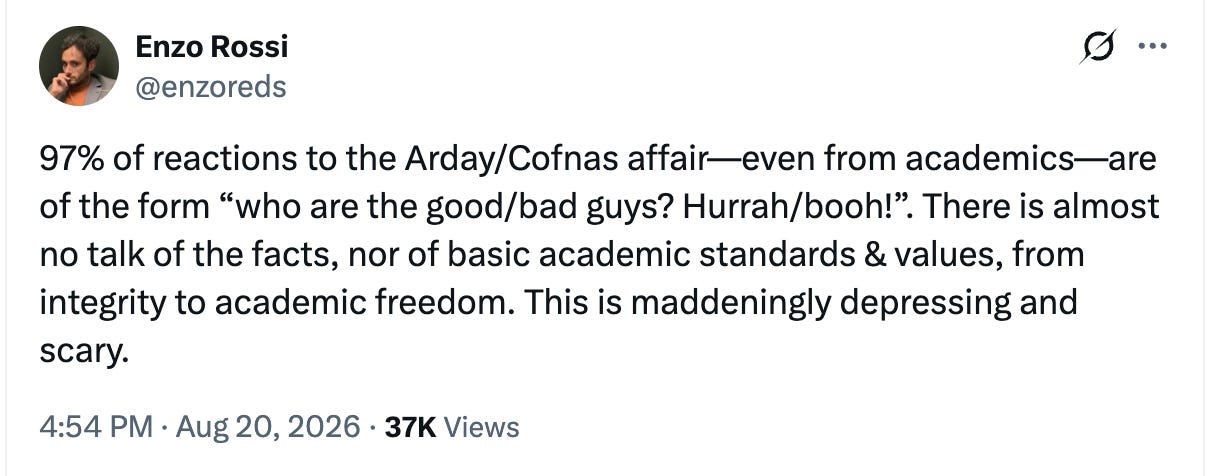
In America, post-vibe-shift, several universities made admirable reaffirmations of first principles. That needs to happen here too. It’s not that I think we should or could keep politics out of sociology or anthropology or literature or, er, politics. It’s that the quest for truth and knowledge should come first and last. That quest is more important than your political views. If you don’t believe that, then I don’t believe you should be in academia. In the last few weeks, I’ve been amazed at how few academic leaders in Britain have been prepared to stand up for academic standards and for the academic ethos. If people like Runciman and institutions like Cambridge don’t believe in them anymore, why should anyone else?
After the jump: a note on the Arday aftermath, plus a Rattle Bag of goodies for the head and heart. Please consider signing up - paid subscribers get the best of the The Ruffian and make the whole thing possible.
