


Catch-up service:
Are Parents Too Close To Their Children?
Postcard From Venice
5 AI Failure Modes Shared By Humans
Why Are LLMs fixated on the number 7?
The Emperor’s New Diplomacy
Successful Politicians Are Pattern-Breakers
NB this is a bit longer than usual, apparently I had a lot to say. It contains a few links to X; apologies to those who can’t access it.
The tone was set by Today, BBC radio’s flagship news programme, the morning after the night before.
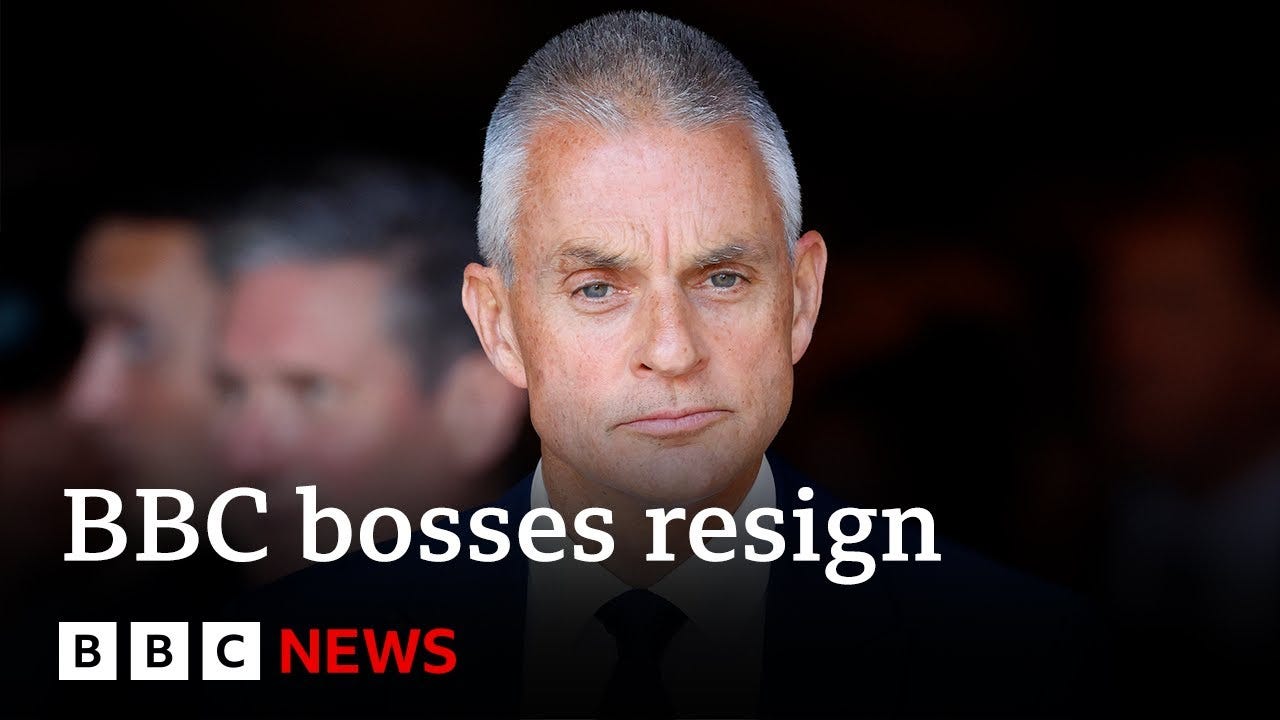
Tim Davie and Deborah Turness resigned on Sunday evening for reasons that weren’t entirely clear, though everyone knew it had something to do with a misleadingly edited Panorama documentary clip of President Trump, who was now training his planetary flamethrower on the organisation.
On Monday morning, Today could hardly get over its excitement. Its chief presenter Nick Robinson, saw fit to deliver an opinionated editorial (twice over), in which he implied Davie and Turness were victims of a right-wing plot led by Robbie Gibb, a BBC board member who used work as a spin doctor for the Tory party. Robinson’s first guest was David Yelland, a former editor of The Sun, and now a breathless purveyor of conspiracy theories. Yelland called it a “coup”, language that soon got taken up by others.
This is a rather over-dramatic way to describe resignations from a public sector broadcaster. And in a coup, someone usually takes over, don’t they? As it is, everyone at the BBC seemed to be taken by surprise. For now, the organisation is leaderless, other than its chairman, Samir Shah, which may amount to the same thing.
It’s not clear why Today thought Yelland was the first person the nation needed to hear from on this matter (nor why the programme also invited on the co-presenter of his media podcast, Simon Lewis, for a slot later in the morning) but Robinson invited him to ramble on incoherently about how this was an “inside job”, whatever that means (what does it mean? Would it have been better if it were an outside job?).
Yelland had nothing to say about the actual criticisms of the BBC made in the Prescott report. For those of you catching up, this is where it started. The Prescott report is an internal memo, written by a former standards adviser to the BBC, the journalist Michael Prescott. The memo, which was addressed to the BBC’s Editorial Guidelines and Standards Board, revealed the Panorama error, in the course of a wide-ranging argument that the BBC’s news reporting is marred by institutional left-wing bias, specifically on US politics, Israel-Palestine, gender, race, and immigration.
The BBC’s management read the memo and sat on it for months, unable to decide what to do with it. Eventually, it leaked to the Sunday Telegraph, at which point the Panorama story hit headlines everywhere and Trump exploded. The BBC’s governance board dithered some more, before Davie and Turness decided that, in the absence of any cover from their supposed bosses, they had to leave.
Back to Today. Over the course of the programme no fewer than seven different luminaries were interviewed, only two of which - Tory MP Caroline Dinenage and the Tory peer Charles Moore - gave any credence at all to the charge of institutional bias. All the others swept it aside, and were allowed to do so by the interviewers. I’m sure that Robinson and Today’s editors believed they being balanced, but this is the problem in microcosm. I love and admire the BBC. I don’t think it is fatally flawed, by any means. But it can be wilfully blind to its own biases, and so can its most passionate supporters.
