


Catch-up service:
Labour Isn’t Thinking
All the Photos I Couldn’t Use For ‘John & Paul’
Why Writers Should Use AI More
Pod: Cass Sunstein on the politics of the Beatles
Pain Is a Mind Game
Who The Hell Is Wesley Streeting?
Thinking By Hand
The highlight of last week’s holiday in Madrid was a trip to the Prado. It is a perfect size for a national art museum, large enough to feel grand without sprawling like the Louvre. The layout is simple, organised around one long central gallery with rooms opening off it. The collection, rather than being a confusingly eclectic mix of every era and tradition, is concentrated on Spanish, Italian and Dutch painters from the fifteenth to nineteenth centuries.
I loved seeing Tintoretto’s depiction of Jesus washing the feet of his disciples. It’s a vast canvas with a stunning trick of perspective: on whichever side you stand, it seems to be pointing towards you. He also does this crazily radical thing of putting his central subject at the far edge instead of in the centre, perhaps to emphasise Jesus’s humility.
But my favourite part was hanging out with Velázquez. I knew it would be. I am no art expert but I know what I like, and I really like Velázquez. I’m not qualified to tell you why he’s so great, but to me he is something like the Roger Federer of art; the one who makes the hardest things look effortless. There’s a lightness, grace and fluidity to his brushstrokes that makes everything he depicts shimmer, as if on the verge of dissolution.
He often doesn’t bother with backgrounds, presenting his figures in blank space, and sometimes leaves the edges of his figures unfinished or blurred. Not only does this make other painters look like dutiful plodders but it conveys a sense of souls floating in time and space, captured in oil and powder for a fleeting moment. The courtier portrayed below, so jolly and so sad, is a vital presence yet also a fragile one, as if about to disappear into the void he stands in. There’s always mystery in a Velázquez painting. He never tells us anything, only gives hints and poses questions.
He’s also an X-ray machine. He zeroes in on a person’s inner life and character, generous but unsentimental. Without flattery, his portraits bring out what is most noble or beautiful about his subjects, while reminding them and us that, however grand we may be, we’re just passing through.
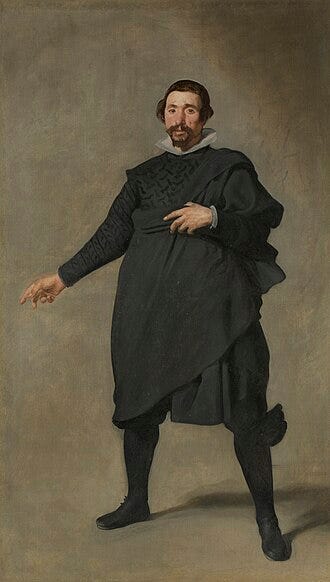
Unlike his older contemporary, Rubens, who was an artistic megastar, féted across Europe, Velázquez wasn’t famous in his lifetime. He spent most of his professional career at the Spanish court, working for his lugubrious-looking patron, Philip IV. His artistic reputation grew steadily after his death until it overtook even Rubens.
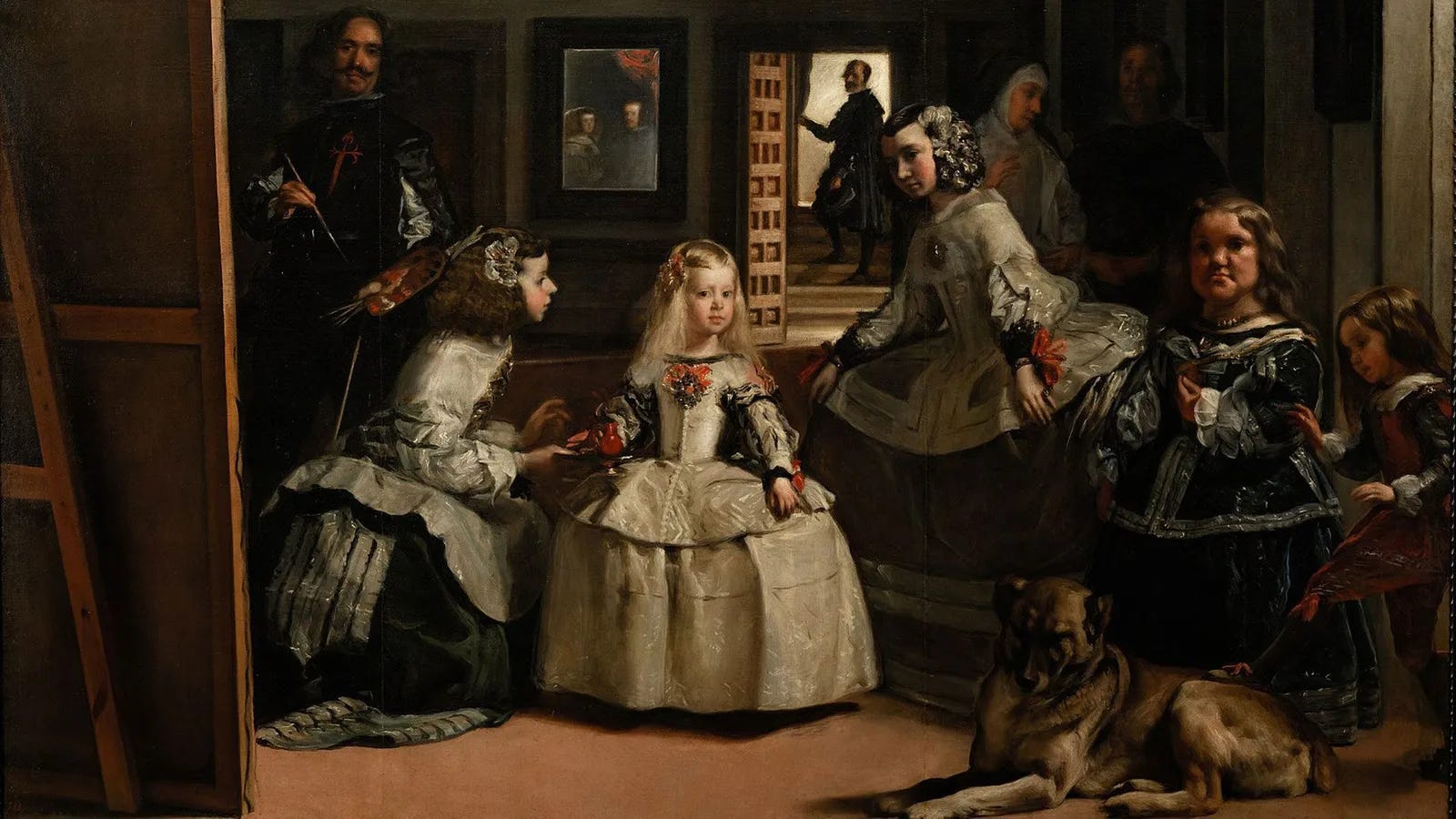
Velázquez’s most famous painting, and the painting that plenty of critics would vote for as the GOAT, is Las Meninas (above, top). I’d seen it once before and now feel lucky to have seen it twice. At the Prado it is on the back wall of a large room, so you view it from a distance as you approach.1 You can, if you like, do what Kenneth Clark liked to do: repeatedly walk towards it until the figures dissolve and all you can see are Velázquez’s loose, louche brushstrokes. Clark was trying to work out the exact point that the spell was cast; when the painting stopped and the illusion began. He never could.
Las Meninas is so complex that I can’t do it justice here. If you’d like to read more about it I’d recommend this BBC piece by the art critic Kelly Grovier. The book that really fed my Velázquez obsession was The Vanishing Man by Laura Cumming, one of the most satisfying nonfiction books I’ve read.
In plain terms, here’s what we’re looking at: the artist himself painting his patrons, the king and queen of Spain, in the company of their five year-old daughter and assorted attendants. In the dim room, the little princess shines, under the eyes of her parents, just out of frame. We can only see the king and queen in a mirror, and that’s because, in the illusory space of the painting, they are standing where we’re standing.
This is what makes Las Meninas so disorienting and enchanting. Both the artist and the Infanta are gazing at us. It’s our gaze which lights up the Infanta, now long gone from the world. It’s us that Velázquez is so coolly appraising, and while we stand in front of his painting, it’s us that he’s creating. Meanwhile, a servant waits, slightly impatiently, to usher us into the next room. We have an appointment that can’t be missed.
Velázquez weaves together the mundane and the ethereal, the worldly and the transcendent. Nowhere is this more apparent than in the red cross painted on his chest. The cross marks him as a Knight of Santiago, an ancient and exclusive Catholic order. Las Meninas was painted in the 1650s, when Velázquez was in his fifties (he died at the age of 61), at a time when officials were thwarting his efforts to join the order. By this stage he was a highly valued courtier but he longed for the aristocratic prestige that came with membership. He kept prompting the king to make applications to the Pope on his behalf and spent a lot of time poring over his family tree, searching for evidence to prove he was worthy.
It’s funny and oddly reassuring that a supreme artist should care so much about worldly status. What he did with the brush was worth infinitely more than membership of any society. But it didn’t seem like that to him, or perhaps it did, but only fleetingly. Reading about Velázquez’s social climbing reminded me of Shakespeare. The two artists are often seen as kindred spirits, with the same miraculous ability to see into any human soul. But both had these worldly worries too.
When he was a young man, Shakespeare spent years petitioning the College of Heralds to grant his father a coat of arms. He was finally granted it in 1596. It clearly meant a lot to him. In practice it meant he got to put “gentleman” after his name (though not “sir” before it - he was still ranked below knights). The motto he chose for his coat of arms, Non Sanz Droict (Old French for "Not Without Right") is surprisingly lame. I often think that if I could meet anyone from history, it would Shakespeare, but I’m haunted by the thought that the author of Hamlet would only want to talk to me about how he came to choose a specific shade of gold for his escutcheon.2
Michelangelo also suffered from chronic status anxiety, despite being the most acclaimed and wealthy artist of his time. He was obsessed with the supposedly aristocratic origins of his family, the Buonarroti. According to what his biographer, William E. Wallace, calls “the creative genealogy of the day”, the Buonarrotis were descended from the counts of Canossa, an ancient and legendary family. Michelangelo believed that “imperial blood” flowed in his veins.
Being known only by one name sounds rather chic to us but Michelangelo might not have been so pleased to hear how he is referred to now. In his world, being able to use a surname in correspondence was a sign of status. After 1526, he stopped signing letters Michelangelo “sculptor” and started signing them with patronymic and surname: Lionardo di Buonarroto Buonarroti Simoni.
He was very keen that his relatives should burnish the family’s image. In a letter, he urges his nephew to acquire a larger, more impressive house: “I say this because a noble house in the city brings much honour, because it is more visible than other possessions, and because we are citizens descended from one of the noblest families.” (You can imagine his nephew wincing at once again having to read Uncle Mike droning on about the need to keep up appearances).
Michelangelo saw himself as an aristocrat who made art rather than an artist with aristocratic connections. In the sixteenth and seventeenth centuries, the social status of artists increased, partly thanks to the grandeur of Michelangelo) and because it became more legitimate to attribute nobility to achievement and virtue, rather than just to birth. But Shakespeare and Velázquez still remained stuck in the liminal zone, convinced that it was their work which made them great but uncertain if anyone else saw things quite the same way.
Both were capable of reflecting on the ironies of their position. In The Tempest, Prospero, with whom Shakespeare seems to identify, floats far above the concerns of mere mortals, yet is also desperate to remind everyone he is the real Duke of Milan. “Every third thought shall be my grave”, he says. I take this to mean that when he’s not having deep thoughts about mortality he’s obsessing over how the hell to recover his kingdom and his title.
In Las Meninas, the artist, having arrived at court thirty years earlier as a mere servant, steps boldly into the frame while relegating his master to a blurry image at the back of the room. It’s as if he’s reminding Philip that the king’s prestige is built on Velázquez’s image-making. But the painting doesn’t quite tell us if Velázquez is an all-powerful magician or a member of staff.
This one is free to read so feel free to hit the green button and share. After the jump: why I doubt that the Nowak case was really about anti-racism. Plus a Rattle Bag of good things, including my thoughts on the new McCartney album. The Ruffian depends on paid subscribers. Please consider taking one out, it’s very good value, and very high status.
