


Those of you who follow British politics (which I realise isn’t all of you, but stick around because the lessons here are universal) will have been transfixed by Tory in-fighting this week. The upshot of which has been, well not a whole lot really. The Prime Minister is staying where he is, for now. His party will continue to sink into the mire; his government will continue to flail. At some point the Tories will face a general election, either with Johnson or without him; either way I expect voters to exact a terrible retribution.
At least, I think they will. I would be more confident of saying so if I were more confident in the Labour leader. Elections aren’t referenda on whether a leader or a party is good or bad; they are choices between competing options. It’s not yet clear that Keir Starmer is going to make the electorate’s choice as easy as it should be.
I am generally positive about Starmer. I think he is the best leader available to Labour. I hope he becomes Prime Minister. I’m almost pathetically grateful to him just for being a sane and credible Opposition leader, the first for over a decade who at least passes the bar of “seems like he could do the job”. He is a decent man who has had a career of genuine accomplishment outside politics. He’s assembled an effective shadow cabinet, and he leads in the polls. But the lack of genuine enthusiasm for him, even among his supporters, makes that lead seem awfully fragile.
Broadly speaking, there are couple of reasons for this. One is that he hasn’t yet set out a fresh and convincing vision for the country under a Labour government. The other is that whenever he opens his mouth, voters either wince or tune out. The first problem is much discussed among political commentators. It involves the serious, manly stuff of policy, governing, narrative. The second tends to be referred to only in passing, because it seems superficial and slightly frivolous. But in politics - in life, really - the superficial counts for more than we like to admit.
If you haven’t already, and if you can bear it, take a look at Starmer’s response, above, to the failed Tory rebellion against Johnson. This is about as open a goal as you can get, and he fluffs it. I will put aside the content of what he says and focus on presentation. This is, after all, how most voters process political content. It’s not that they’re uninterested in substance so much as they will only hear out politicians who get and keep their attention. Politicians compete against everything else in life for this commodity, and so much of life is more compelling than politics.
Starmer comes across as stiff, hesitant, and cramped, like he’s rigged up his lectern inside a portable toilet. His evident discomfort immediately makes us feel uncomfortable. His hand rises and drops as if jerked on a string from above. Worst of all: every few words, he peers down at his script. Why did he need to read a one-minute speech? He had days to prepare his statement, longer than politicians usually get to respond to big events. The point of memorising a script, as any actor or broadcaster will tell you, is that you can forget it. Once the words are ingested the ideas they express become part of you, which means you can focus your energies on making those ideas land in the minds of your audience. Spontaneity works much better with preparation.
Even if he and his team had prepared a decent visual presentation of the statement they would still have been left with the problem of Starmer’s voice: nasal, reedy, pinched. I’m not sure how many voters would explicitly mention it, but I am sure that for many of them his voice alone is a reason not to listen to him, and for some, a reason to dislike him. I realise this is quite a personal criticism, and it can verge on mean - another reason that commentators, sympathetic ones at least, don’t like to dwell on it. But the sound of a leader’s speaking voice is such an important factor in politics that it shouldn’t be avoided.
Note that I’m not talking about accent, here, but ‘vocalisation’ - pitch, tone, timbre, stress and rhythm. Vocalisation is one of the most important and most overlooked factors in whether or not a person succeeds in any field that requires persuasion of some kind.
Whenever you encounter someone, either in real life or over media of some kind, much of the way you feel about that person - and what they’re saying - is unconsciously determined by the sound of their speaking voice.
Humans are pretty shallow in some ways. We are evolved to be intensely social creatures, not in the sense that we’re all extroverts, but in the sense that we live together or die; our biological niche isn’t a jungle, or a desert, but other people. Given limited energy, our brains must make snap judgements about who to depend on, based on “thin slices” of behaviour. These instant perceptions can be faulty and prejudiced but they’re often surprisingly accurate, and either way, they influence our decisions.
For instance, there’s plenty of evidence that we make spontaneous judgements about people based on their face, including judgements on how likeable, how trustworthy, and how competent they are, a phenomenon that can be used to predict elections. This is why Starmer’s note-peering is so problematic, by the way - it makes him look shifty, like he literally won’t look voters in the eye. Starmer actually has a good face, when we can see it properly: he looks the part, a serious asset in a communication environment in which attention is very scarce. Less fortunately, he has that voice.
Think about successful leaders: most of them have voices you would like to listen to if you didn’t know who they were. Boris Johnson has overcome his many flagrant shortcomings to make it to the top partly because his voice is expansive, resonant and deep. For a skinny guy, Obama had a surprisingly mellifluous baritone. Tony Blair’s voice was a little light (it could make him sound insubstantial versus the rumble-voiced Gordon Brown) but he knew how to exploit the musicality of speech. Margaret Thatcher - well, her voice wasn’t one of her greatest strengths but what’s interesting about her is that she decided to improve it, taking coaching to lower its pitch. This was interpreted, at the time, as a sign of weakness. In retrospect it displayed a willingness to listen to uncomfortable advice, and a determination to be as ruthless with herself as she knew voters would be.
In the words of neuroscientists who study voice perception, the voice is an ‘auditory face’. It plays a central role in our instant impressions of people and thus a central role in who we choose as leaders. Let’s start with voice pitch, which is just one, rather crude measure of the importance of vocalisation. It’s now a well-evidenced finding that voters prefer candidates with lower voices. ‘Deepness’ of voice is an advantage to men in business too. (I wouldn’t assume that the pitch effect necessarily puts women at a permanent vocal disadvantage. People respond to different sexes differently; it would anyway be hard to distinguish the effect of vocalisation from sexual prejudice more generally - but more research needed). It may be that a lower pitch is particularly attractive to voters on the right. Voice pitch is a rather unreliable signal: it doesn’t correlate with leadership ability. But like it or not, it matters.
As I was drafting this piece I came across a Twitter thread posted by Jamie Susskind, a barrister and writer. At school he was a competitive debater and eventually became captain of the England schools team. He tells us about a successful competitor he came up against a few times. The guy was a gifted debater but what really set him apart was his voice: it was much deeper and more resonant than most seventeen-year-olds, which imbued everything he said with ineffable authority. “Even if your points were smarter, this cello of a voice would drown you out. You would be forgotten about, along with the other squeaky woodwinds.”
When Susskind came up against the cello for the final time, in a trial for the England team, he despaired. But after his opponent had sat down, the judge stood up to give his verdict, and said: “Just saying something in a really deep voice doesn’t make it right.” For Susskind, this was a revelation. He took this lesson from it: “If you have no good points to make, it doesn’t matter how you make them.” But of course, we could draw the opposite moral from this story, which is that it very much does matter. Susskind also frames the story as being about social privilege, since this boy had a posh accent. I’m not sure it’s necessarily about that. Accent certainly matters, particularly in this country, but it’s not always the most important information we get from a voice. The acoustic quality of a voice can provide quite enough unearned advantage in itself.
Here’s some evidence for that. When people without expertise in physics watched a YouTube talk given by a physicist, they rated it nearly 20% better when they heard it high quality audio versus those who heard it in low quality. To be clear, they weren’t just judging the recording; they were forming opinions on the talk, and on the person. Speakers were rated smarter and more likeable when the sound of their voice was better to listen to.
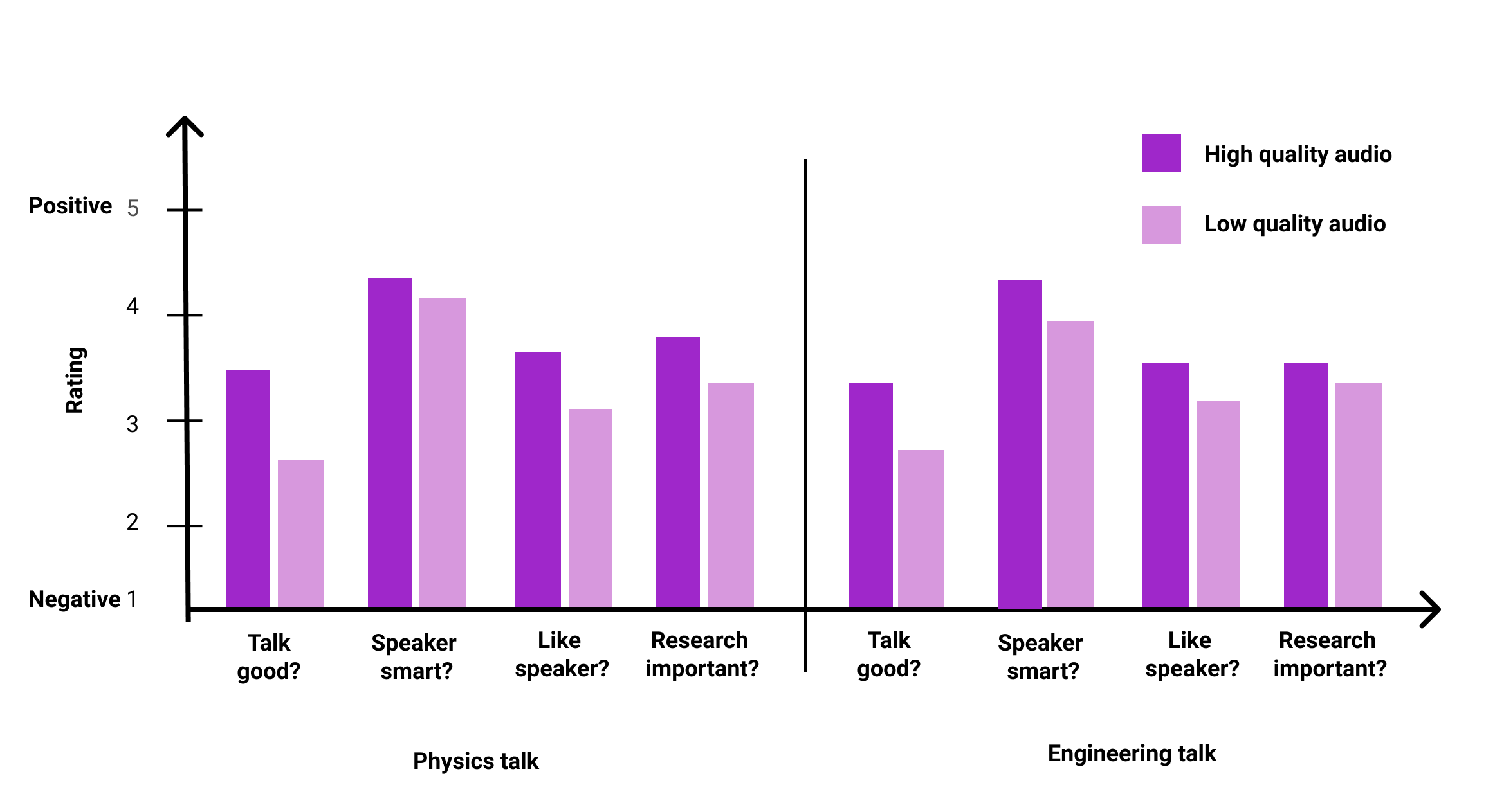
Why you need to get a mic for Zoom calls. (Study here.)
Vocalisation conveys a lot of compressed information about what a person cares about and even what they’re thinking. This study reviewed 3000 hours of audio recordings of oral arguments before the U.S. Supreme Court. The researchers found that the level of emotional investment a justice had in an argument, as measured by vocalisation, was a reliable guide to their eventual votes on the cases. The sound of their voice was just as predictive of their decision as the content of what they said.
In a paper from 2020, researchers found that people who spoke louder and who also varied the volume of their voice were more persuasive. No, this doesn’t mean you should go into your next meeting and start shouting and then whispering, like a drunk Al Pacino. Those features of speech are really just crude measures for what the paper calls “paralinguistic” cues - the signals we get from the sound of speech rather than from its content. The researchers make a subtle point about why someone who uses their voice skilfully becomes more persuasive. It’s not that they are somehow tricking the listener into agreeing with them - the listener may be perfectly aware that the speaker is deploying paralinguistic cues. It’s that the speaker sounds more confident in what they’re saying. They sound like they really believe it and - at least in this experiment - that also makes them seem more competent and more likeable.
One of the things that people pick up from the sound of a voice is whether the person respects who they’re talking to. Nicolas Camp, a psychologist at the University of Michigan, published a study of traffic stops, using a database of recordings from police body cameras. He played tapes of traffic stop encounters from an anonymous city in the US to a panel of respondents and asked them to judge how respectful the officer was being, without knowing who they were talking to. Crucially, he manipulated the tape so that the words were indecipherable. All the respondents had to go on was what Camp calls ‘prosody’: pitch and volume, but also intonation and rhythm (students of English Literature will know it’s a term used to analyse poetry). That was enough to make a judgement, and Camp found that police officers were consistently more likely to use a disrespectful tone of voice when talking to black drivers.
The tone of a speaking voice can communicate more than words do. In a 2015 study, researchers recorded hundreds of conversations from marriage therapy sessions. They asked relationship experts to listen to the tapes and make predictions about the couples’ future. They also developed an algorithm that broke down the couples’ speech into acoustic signals: pitch, intensity, wobbles or coarsening of the voice indicating stress or high emotion. The progress of the couples was then tracked over the following five years, and the acoustic signal analysis proved a more accurate predictor of the couples’ happiness than the wisdom of relationship experts.
The research on vocalisation’s social effects is dispersed across different fields and it’s a bit spotty. There an over-emphasis on pitch - deep vs high - because it’s easy to measure, and a limited understanding of the sheer variety of human voice, particularly female voices. None of these studies can define what a persuasive voice sounds like, because voices can be persuasive, attractive, compelling - or not - in many different ways. What I think this research does show is that vocalisation is hugely important to the way we relate to each other. It exerts a powerful hidden influence on the judgements we make about people - including and especially leaders.
That leaves the question of whether leaders can do anything about it. Isn’t a voice something you’re stuck with? Well, no, not really. Voice isn’t like height (another of those superficial factors that matter a lot). It is much more malleable. It’s true that biology - the vocal equipment you’re born with - constrains the expressive range of a person’s voice, but within that range there’s considerable variation. Here some evidence:

Now, he’s evidently a bit self-conscious about being in a café and talking to a camera, but given that, doesn’t his voice sound more open, more relaxed, more easy on the ear? That familiar nasal quality is there but it’s not as prominent.
The truth is that Starmer’s vocalisation has got worse since he became a politician, and quite possibly since he became Labour leader (the podcaster Cariad Lloyd has been courageous enough to make an informal study of this question). If it’s changed for the worse, surely it can change for the better.
If leaders like Starmer don’t use voice coaches that’s probably because they view vocalisation as a shallow presentational problem that isn’t worth making time for. They may also be wary of being made to conform to some model of ‘good speaking’ that doesn’t suit them, although I suspect the good voice coaches are like the good presentation coaches: they don’t give you a set of rules for the ‘right’ way to present or speak, but essentially show you how to be more you.
It’s a problem that has to be tackled from both ends, of course. Vocalisation isn’t just about vocal cords - it’s about how you feel about who you are and what you’re saying. The reason it is so communicative is that it reveals so much about us, whether we want it to or not. When you’re uncertain of what you think and who you want to be, that will show in the sounds you make. Starmer’s vision problem and his voice problem are interrelated. What seems to be superficial actually goes quite deep.

Photograph: Sarah M Lee/The Guardian.
If you didn’t get at least a little joy from the Jubilee celebrations - if you didn’t feel even the mildest twinge of patriotism - I don’t know what to do with you. Seriously, if you missed it, it’s worth catching the BBC’s 90-minute highlight package. Saturday night’s show was spectacular but I loved the wonderfully bonkers parade on Sunday best of all. We’re rubbish at a lot of stuff, but we do national celebrations pretty well.
Any Other Business
An inventory of models for better thinking. This may be the most useful thing I’ve ever posted on The Ruffian.
Or maybe this is: on how to ask better questions.
Tentative but intriguing evidence that younger Americans are less polarised than older generations. Although you may not be delighted to find out what they’re agreeing on.
Marc Rubinstein on the importance of branding to fund management companies. One of them might find an opportunity in the world of books.
Study i: whether they’re terrorists or entrepreneurs, the people who get good at what they do are the ones who learn from their mistakes.
Study ii: people are more pessimistic tend to read more bad news.
Study iii: electrical bike riders are actually getting more exercise than cyclists, on average, because they ride more. Interesting example of how making a ‘healthy’ behaviour more enjoyable is the best way to spread it.
Comprehensive demolition of the phrase ‘science is inherently political’.
Lovely tribute to Ray Liotta from Martin Scorsese.
A list of things you’re allowed to do that you thought you couldn’t, or didn’t even know you could.
Next week I’m flying to New York to see Paul McCartney play (in New Jersey). See you on the other side of his 80th birthday - the real Jubilee…
I think I saw this effect throughout my career - the disproportionate but under-recognised impact of a resonant voice on success or failure. Jim Carroll of BBH once referred to 'The curse of Cassandra' to explain why some of his brightest colleagues simply didn't get heard. He described one brilliant strategist who always seemed to be shouted down. "She was always right, but she always lost." Bet she had a soft voice.
Regarding William Hague: wasn't the most persistent accusation against his voice precisely his accent? His vocalization was never that bad, I'd say. My memory was that his problem was his accent was perceived as a halfway-house between a Yorkshire accent and a RP accent thus signalling both inauthenticity and social climbing.
And now I think about it this is a specifically English thing... rich Welsh, Scottish or Irish accents have always been common in politics.