


Catch-up service:
Thinking By Hand
How To Save Centrism
What the Fuck Are We Talking About When We Talk about Love?
Arteta vs Guardiola
Moon Joy
How Evil Is Mark Zuckerberg?
Giving Advice Is a Treacherous Business
An under-reported trend in British society is the extraordinary rise of long distance running. This week, the organisers of the London Marathon announced that there have been 1.3 million global applications to run in next year’s race, more than double the amount in 2024. Just over a million of those applications were from the UK. That’s 1.8% of the entire adult population.
Personally I hate running, but I’m cheered by this. In a country that doesn’t have many positive social trends to celebrate at the moment, it is a bright spot. Running is healthy and, for many people, therapeutic. The largest number of applications from a single demographic group came from women aged 20-29, the group with the worst mental health in the country. Yes, I’d rather they were socialising more too but it’s still good that so many have found a reason to get out of their homes and their heads.
It’s tempting to think of running as some kind of antidote to technology but it is actually a product of it. Modern running is inextricably tied to the smartphone. Apps like Couch To 5K, MapMyRun, and Strava give novice runners the advice, social connection and incentive structures they need to get going and keep going. Nobody needs a phone, or a smartwatch, to run, but many people wouldn’t be running without one. An absurdly complex technology has enabled millions of people to discover one of the simplest and most fundamental of human activities.
At this year’s marathon, 60,000 people finished the race, watched by about 750,000 spectators. At the front of the race, and the top end of the sport, Sabastian Sawe smashed the two-hour barrier, once thought insurmountable. (He did it with the help of technology too, albeit of a different kind).
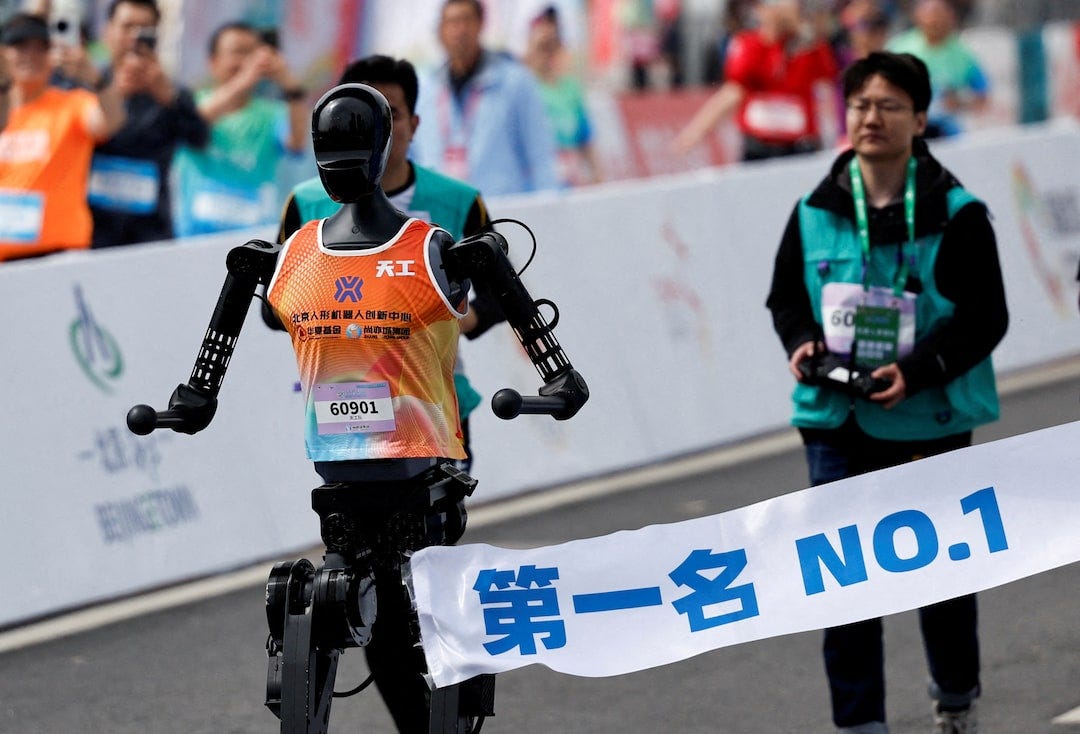
But wait, maybe the whole thing is futile, since the robots can do it better now. Last month, there was a half-marathon race in Beijing, in which robots competed with humans. The robots crushed it. All three podium spots were taken by non-humans. The winning machine, made by a subsidiary of Huawei, beat the human world record by seven minutes. This has been reported as a momentous event. “The robots’ speed far exceeds that of humans,” a spectator observed sombrely, “This may signal the arrival of a new era.”
Or it may not. It’s true that the race displayed Chinese progress in robotics: all of the bots were considerably faster than those entered a year ago. Indeed, that is probably why it was staged. But the premise of a competition with humans is inherently ridiculous.
We already have machines that can beat humans in half-marathons. They’re called cars (and these days they don’t even need drivers). Building a machine that can get around a course at speed is not cutting-edge. Doing so while making it look like a human is harder, but that’s an artificial, technologically pointless constraint. It might force useful innovation of some kind, but it’s mostly about the pictures.
The fact that this robotics showcase was presented and reported on as a sporting contest at all is significant. Whoever was behind it knew it would get more attention that way, because we’re fascinated by sport. But why are we fascinated by sport? It’s not because we want to know how fast a human-sized object can propel itself around a track. It’s because we’re fascinated by humans; helplessly compelled by intra-species comparisons.
That’s why 60,000 people took part in the London Marathon: to discover how they’d fare against fellow runners, and against their past selves. It’s also why so many turned out to watch. The spectators might have been supporting someone they knew or seeking a glimpse of the world’s top runners, but mainly they liked watching strangers do something hard, so hard that there is nowhere to hide. You can’t pretend to be someone you’re not when you’re on the edge of exhaustion.
Regardless of whether they’re wearing a comedy outfit or not, each runner declares themselves a unique individual. They’re all doing the same thing, slightly differently. Subconsciously or otherwise, the runners are comparing themselves against each other and themselves; the spectators are comparing themselves against the runners and each other. Both runners and spectators enjoy being around other runners and spectators.
If you think of the London Marathon as a place where a task gets done - covering a distance in the minimum time possible - you’d be completely missing the point. It is a festival of human comparison and human connection. It is growing in popularity at a time when technology threatens to curtail the scope of human endeavour, and it’s doing so with the help of technology. Perhaps this tells us something about how AI will change the world of work.
