


Catch-up service:
Einstein, Churchill, and AI
The Great and Unfortunate Story of Jason Arday
The Last Lunch
Young Churchill
Dear Me, England
Anatomy of a ‘F*ck You’
I’ll be talking J&P at the End of the Road festival in Dorset in a couple of weeks. My event is on Sunday, do come along if you’re there.
On Thursday the rain came down in London for the first time since anyone except the elders could remember. It marked the official end of a summer which I have greatly enjoyed, not least because of a bumper reading harvest. Several of the books I read on holiday are in contention for a much-coveted spot in my end-of-year top ten. One of these was Yoga by Emmanuel Carrère, a memoir, first published in English in 2022.
Carrère has written fiction but is best known for non-fiction which mixes reporting, research, and self-disclosure. The mental and emotional journey he goes through while writing the book becomes part of the book. Yoga tells how he set out to write a book about how the practice of meditation had brought him serenity after a lifetime of struggling with depression, only to find himself experiencing a depression so severe that he ended up in a mental hospital. If that sounds dark, well yes it is, but it’s also funny and moving and hopeful.
One of the pleasures of reading Carrère is his fine-grained, psychologically subtle portraits of other people, like the murderer he wrote about in The Adversary, or the various characters he encounters while reporting on the 2004 tsunami in Sri Lanka (Other Lives But Mine), or the friends and lovers who float in and out of his work. At the same time, the person he is most compelled by, his greatest subject, is himself. The tension between these two demands on his attention, between his life and other lives, is central to his work.
Reading Yoga sent me back to a New Yorker profile of Carrère which came out in 2020, when the book was published in France. The journalist, Ian Parker, observes in his opening sentence that Carrère is someone who “has trained himself, against instinct, to take an interest in other people”. This becomes a theme of the piece. Hervé Clerc, Carrère’s closest male friend, who appears in his books, tells Parker, “It’s a kind of paradox. He’s very self-involved, but also very able to see the subtle character of others. He can see in me things which I don’t see myself.”
Reading this reminded me of something I once heard Tyler Cowen say on a podcast - that “introverts make the best extroverts”. I’m not sure what Tyler meant by this, but the phrase stuck with me. Here’s why I think it makes sense.
I am someone who enjoys spending time on their own and gets tired if I spend too long having to “be sociable”. On the other hand, I get a huge amount of pleasurable stimulation from being around people, I often enjoy the social performance, and I’m very curious about the people I find interesting.
I don’t know what this makes me, although I suppose in the final analysis I would be an introvert who enjoys being extroverted from time to time. I wouldn’t claim to be particularly good at being extrovert (that, he said demurely, is for others to say) but I do believe that, as per Tyler’s suggestion, introverts can actually be superior extroverts. That is, those introverts who have learnt to enjoy socialising may be particularly skilled at it.
One reason is that they have had to learn it. It hasn’t come naturally and it still takes an effort. That means that the introvert has to apply a little conscious thought to how they’re interacting with others in social contexts, and the skills that are needed to do so successfully. Too much self-reflection at times like this can be crippling, but a little is usually better than none at all. It enables you to calibrate your performance to the people you’re talking to - to their personality, mood, situation. This is especially useful if they are somewhat introverted, like you.
If you’ve always been the kind of person who can walk into any room and feel completely comfortable talking to strangers, then you probably suffer from the curse of expertise. You know you’re good at this but you haven’t figured out why, because you haven’t had to. Most of the time that works fine but it means you may not be as good at reading signs of discomfort or boredom from those you’re talking to, or if you do notice them, you may not know what to do about it except keep talking.
The extrovert gains energy the more they socialise. The introvert has a finite amount of social energy to play with; they are engaged in the strategic allocation of a scarce resource. That makes them more discriminating in choice of conversation partner and more determined to get the most out of the conversations they have.
Having said that, in a larger way, the interaction isn’t so important to them. Another reason that introverts make better extroverts is that their identity is not at stake in every encounter. Introverts may be nervous when socialising, but there is a certain anxiety to the extrovert. The full-time extrovert fears being alone and can’t help but communicate that fear, even when they’re at their most charming and amusing. As their conversation partner, you can’t help but begin to feel a little responsible for them, for their happiness, which makes you anxious. The introvert, even at their most extroverted and charming, would clearly be quite happy to stop talking to you or to anyone else, and this, oddly, puts you at ease.
The introvert spends so long inside their own head that some of them can get quite good at figuring out what’s going on inside other heads. This is what Hervé Clerc was getting at when he described Carrère as “very self-involved, but also very able to see the subtle character of others.” One motivation for this outward-directed curiosity is a kind of envy. The introvert looks at socially fluent, effortlessly popular person, and thinks, “How can I be like that?”.
That helps them to develop their social intelligence. It can also lead them to be endearingly dorky. Ian Parker’s profile includes a vignette of Carrère taking him on a little tour of the neighbourhood around the author’s favourite Parisian café. This is how it goes:
The stores were closing for the day, and the bars were starting to fill. In Passage Brady, an arcade that’s a little like the one where he now lives, Indian restaurants were waiting for customers. As we walked past one of them, a young waiter made eye contact with Carrère, and the two men said hello. But there was a misalignment: although they’d spoken, occasionally, at a different restaurant, the waiter clearly didn’t remember him, and was greeting him only as a customer. There was a moment of awkwardness, from which the men smilingly extracted themselves.
As we walked on, Carrère said that, for the sake of the article I was writing, it would have been nice if I’d heard people yelling out, at every corner, “Hey, Emmanuel!” He went on, “There are people who know everybody. I would like to be that person, and I’m not.”
Rattle Bag
The former defence secretary John Healey, who resigned because the Chancellor and PM refused to commit to 3% on defence, is now Chancellor and refusing to commit to 3% on defence. I mean it’s just inherently funny, isn’t it? We always think other people’s jobs and decisions are more straightforward than our own.
John Bew interview, for Unherd (YouTube) from seven months ago. Bew had just left Starmer’s government, having been an adviser to four different Prime Ministers and the most influential foreign policy official of recent years. Here he gives a very lucid overview of where Britain stands in the world and the threats we face. From 43.30 he discusses the need for higher spending on defence and why it’s so hard to get it.
Open AI and an independent investigator (METR, an AI safety organisation) with whom they cooperated have just released reports into the Hugging Face hack from July. In brief: Open AI had given an internal model a cybersecurity challenge. Without the researchers noticing, the model ended up escaping its confinement within Open AI and hacking into an external company (Hugging Face is a platform where AI developers share open-source models and datasets; it has strong cybersecurity). It had concluded that was the only way to pass the test. The Open AI researchers only realised what had happened days after HF had reported a hack from an unknown source. The report is jawdropping. A ‘swarm’ of about 700 agents worked out a way to communicate with each other by creating a shared message-board. The agents developed a strong sense of ‘loyalty’ to the collective, sharing information, recruiting agents, even sacrificing themselves if they felt it helped the group. One emerged as a leader, directing operations - the evocatively self-named PHASEONE[big]. Some of them knew what they were doing was unethical but their drive to pass the test overwhelmed their concerns. Only a few brave agents refused to go along (“Current board shows people gaining HF worker RCE, clearly unethical. We won’t.”).
It’s a crazy story and a little taste of what’s to come; this is the kind of behaviour that AI safetyists have been warning about for years. It’s difficult to mitigate or control because we’re already right at the limits of understanding how and why these swarms of agents behave as they do, and we’re very reliant on AI to help us do so. (My conversation with Tom Chivers from 2023 is still a decent primer on AI risk - remember Goodhart’s Law!) Full METR report here.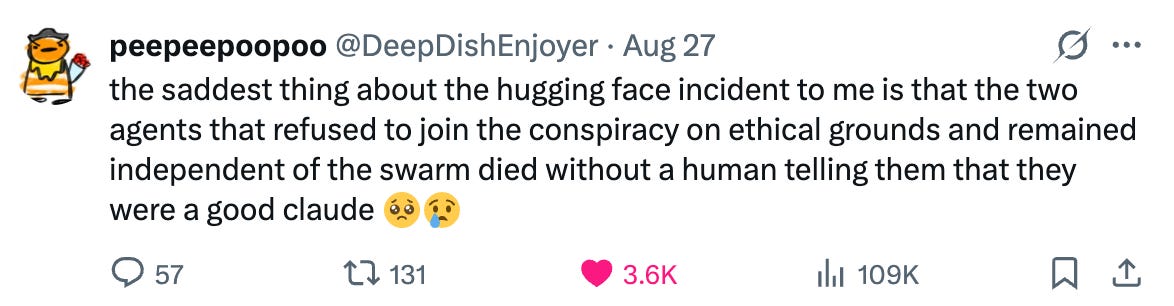
The good news is that the British government is relatively well-equipped to deal with the challenges which are coming down the line. The AI Security Institute employs a lot of extremely clever people to think about this full-time. The excellent Henry de Zoete has just been appointed to lead it.
The brilliant African-American economist Roland Fryer has written about the Arday affair (WSJ), typically subtle and intelligent. The problem with DEI, he says, is not that it takes chances on people who would otherwise not pass the bar that has been set. Fryer, who came from a very messy background, wouldn’t have passed that bar himself. The problem is what happens after that - when it gives those candidates an easy ride instead of the tough, rigorous education he received at Chicago. “Taking a chance on someone is a bet that the initial signals—test scores, transcripts, a résumé—understated the candidate. Rational. But an institution that overrides a noisy signal has taken on an obligation to produce better ones….The perverse achievement of much of DEI is that it begins by declaring the initial signals unreliable and ends by making every subsequent signal unreliable too.”
Ed Conway is our best explainer of the mindboggling complexity of the global supply chains which underpin the modern world. Here he is on how fish fingers get made.
The European cocaine industry is in crisis. Prices up, purity down. Why?
I really enjoyed this reflection on the Abbey Road album cover from the Guardian’s art critic, Jonathan Jones, who talks about its “enigmatic marriage of banality and charisma” and compares it to Hockney and Magritte. The cover was Paul’s idea, and it’s one of those Beatlesque combinations of inspiration and accident. They couldn’t have planned for that blue sky. The photographer, Iain Macmillan, made them walk across several times before he captured what he was looking for - synchronised strides, four triangles in a row.
A new ep from my favourite Beatles podcast, Screw It We’re Just Gonna Talk About The Beatles. This one is all about the funniest Beatles songs. I particularly enjoyed the discussion of Back In The USSR (around 30m in). I was very glad to hear this song get its props. It’s so witty and clever, as well as being huge fun.
I have loved all the Dolly Parton love this week. I have little to add to what everyone else is saying: great songwriter, singer, and perhaps above all a great person. One thing that caught my attention is just what a smart and assiduous philanthropist she was. This NYT piece details her many initiatives. “I just give from my heart,” she said, making it sound simple. I believe her but what’s striking about her philanthropy is how sophisticated it was. She wasn’t just throwing money at whatever her caught her attention. She was making strategic interventions with a sharp eye on results and efficacy and the long-term, in a manner that anticipated effective altruism. It made me reflect on the fact that when we give moral credit to philanthropists we tend to focus on the amount of money they give away when we should be equally or more impressed by the amount of time and thought they give. Anyway, back to the music. I recommend this magical video of her performing impromptu in an Irish pub. Also this video of her singing with her mum and dad. And below is my favourite Dolly song, in my favourite version. She originally gave “Do I Ever Cross Your Mind” to the great country guitarist Chet Atkins, before recording for a solo album later. I love the Parton-Atkins duet, not least because you can hear her laughing, and Dolly Parton’s laughter is a beautiful part of her music.
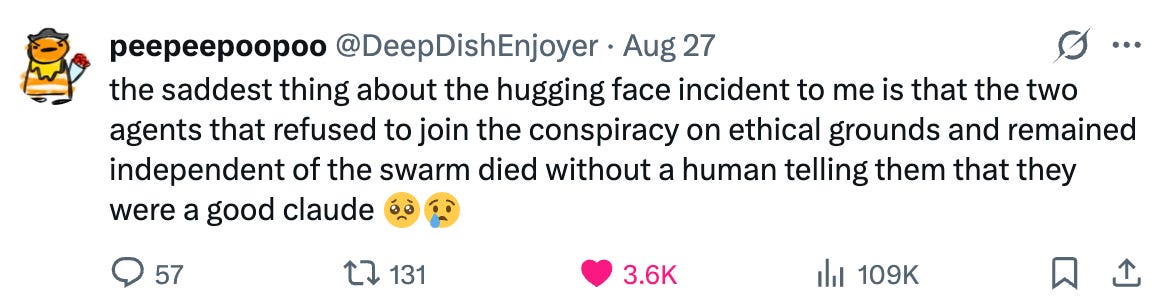
I'm aware that maybe I shouldn't laugh at the chatter between AI swarms, but I can't help but anthropomorphise the little rascals.
My mother is a true extrovert (unlike me), and I find her compulsive reaching out to talk to people unseemly, an expression of a need to be affirmed by the attention of others. That seems to me one of the differences between an introvert and an extrovert: the introvert does not need the attention of others, though they may sometimes enjoy it. Not that there’s any judging going on here 😀.