


Catch-up service:
Why Does Every Society Invent the Same Things?
Seven Rules of Good Conversation
Why I Won’t Reply To Your AI-Generated Email
Why Introverts Make the Best Extroverts
Politics Is Making Academia Stupid
Einstein, Churchill, and AI
Nikole Hannah-Jones, a Pulitzer-winning reporter on race and inequality, has written an extraordinary essay for her employer, the New York Times. In it, she reflects on her decision to send her daughter to bad schools, out of principle. Despite having access to high-performing schools in her area of Brooklyn - schools with largely white, middle-class intakes - Hannah-Jones and her husband decided to send their daughter to largely black, largely low-income schools.
They did so out of solidarity with poor black families. It seemed unfair to them that their daughter should be set apart from and above other black kids in a selective school system that, in her view, discriminates against them. Hannah-Jones and her husband believed they would be able to improve their daughter’s schools by virtue of their middle-class connections, money and advocacy, and that they could compensate for any shortcomings in their daughter’s education with private tuition.
It did not turn out well. The essay opens with a dramatic scene in which her daughter, Najya, then 13 and at middle school, confronts her mother in the car home from school. Najya and her trio of “black girl nerds” had been plotting their futures in higher education. When they looked up how their school did in the academic rankings they discovered the unpleasant truth. Now, Najya wanted to know why her mother sent her there despite the better local options.
Hannah-Jones answered her with arguments that she had made many times in public (ten years ago, she wrote a piece for the same paper about taking this decision for Najya’s elementary school). She talked about standing in solidarity with other black families. She said that schools should not be judged solely on test scores, anyway. But in the face of her daughter’s uncomprehending fury, her conviction wavered:
“Because other kids are disadvantaged, you didn’t want to put me in a great school?”
Najya was asking what I’d accomplished by not choosing the “best” school for her. And the honest answer is, I don’t know. When it comes to the choices my husband and I have made about public education, these days I feel that I failed both my values and my child.
The essay then goes back in time to recount all the problems that Hannah-Jones and her daughter had faced - first at Najya’s elementary school, and then at her middle school. Both schools were terrible. At the elementary school, the school cafeteria was chaotic, kids running wild and fighting with virtually no adult supervision. The school’s principal proved very difficult to engage and its teachers seemed to take an awful lot of time off. On doing her own investigation of Najya’s reading and maths scores, Hannah-Jones discovered that nobody had been checking her error-riddled work.
The middle school seemed better, at first, but Najya became frustrated with how badly behaved her fellow pupils were. The teachers spent so long dealing with disruptive pupils that they had little time left over to actually teach. While poorly behaved pupils were rewarded just for not breaking the rules, pupils who consistently behaved well, like Najya herself, were overlooked. The school had low academic standards, too. Najya kept scoring well on her tests and believed she was doing well. But it was all too easy. When she took the entrance test for New York’s most prestigious state high schools, she failed.
Following the confrontation in the car, and after much soul-searching, Hannah-Jones decided to let Najya choose which high school to go to. Najya identified the top-performing schools in the area as her preferred options. This meant a heavily white, middle class school, and one with academic selection: the kind of school to which Hannah-Jones was opposed on principle. “By letting Najya make the decision, I was allowing my child to attend a school that was a beneficiary of the inequality that defined the city’s educational landscape.”
Najya got the school she wanted, but was almost overwhelmed by the amount of work she was asked to do. Low on prior knowledge and having never learnt the skills of independent study, she floundered, failing test after test. “Suddenly the child whose identity had been the nerdy honors student was working harder than she ever had and barely keeping up.” After Hannah-Jones intervened, the school’s teachers put in a lot of extra work with Najya to bring her up to speed, and Hannah-Jones paid for private tuition. Najya got there in the end. But it was clear to Hannah-Jones that Najya’s middle school, which is called Unison, had left her woefully under-prepared, and that less fortunate kids would not have been able to recover from it.
The essay has triggered a firehose of commentary. Much of it has focused on the decision of its author to choose a school on ideological grounds at the expense of her daughter’s education. I’m going to put that to one side here, since I want to focus on the underlying questions about education. I’ll just say that, firstly, whatever you think about her decision, it was not hypocritical in the manner of progressives who talk about social justice but send their kids to a fee-paying school. Hannah-Jones paid a cost for her principles. The question she explores, quite unflinchingly, is whether it was fair to impose that cost on her daughter. Secondly, this is a very good piece, grippingly written and genuinely, almost painfully self-lacerating. Read it if you can. Finally, I note that Hannah-Jones responded patiently and with good grace to her critics in the comments.
Anyway, let’s look at what it tells us about schools and politics.
Hannah-Jones interviewed the principal of Unison, Emily Paige, for her piece. That must have been a tricky one for Paige - “Hey, would you like to talk to this high-profile journalist who believes your school failed her daughter?”. But Hannah-Jones is sympathetic. She notes that unlike a lot of state schools in New York, Unison is not selective. Children arrive at it having been educationally neglected. It has a disproportionate number of students who are poor and who are diagnosed with learning disabilities. In fact, Hannah-Jones ascribes almost all the blame for the low standards of schools like Unison to a system that “segregates” children by ability, and shoves black children from poor families into underfunded schools.
There is certainly something to this, but she exaggerates the contribution of school funding to inequality, and, crucially, underweights the agency of individual schools and teachers. She leaves out the “educating” part of education policy altogether.
Hannah-Jones notes that schools in predominantly non-white districts received less funding; what she doesn’t say is that, while that may be true at the national level, it isn’t in New York, which gives extra funding to schools with disadvantaged students. In fact, Najya’s schools probably receive more money per pupil than their predominantly white counterparts. According to official data, her abysmal elementary school spends $52k per pupil and has an average class size of 10. If nobody is on duty at lunchtime, and nobody is properly marking or grading work, that is not down to a lack of money or staff.
Paige says, and Hannah-Jones agrees, that schools like Unison have no good options, since the real culprit is systemic inequality:
‘“It’s very, very hard,” Paige told me. “There’s no model out there for holding all of these truths, these complex truths, all at once.”’
It is quite common for people who don’t want to confront uncomfortable truths to throw up their hands and say, “Ah, it’s all so complex.” Actually, the reason Unison is such a poor school is in plain sight. Paige, to her credit, does reach a moment of clarity in her interview, and Hannah-Jones, to her credit, quotes it. Paige reflects on the importance that Najya attached to homework, which Unison had eliminated:
“I remember Najya sitting here in my office and saying, ‘What about us?’ It feels, to me — the way that I understand when the kids are asking that is, ‘Will you honor my academic self?’ That’s what she’s asking. And I think in not giving homework, we didn’t honor their academic selves. And that’s where I could cry, because it’s just awful…It is important to not, in our pursuit of being antiracist, lower expectations…Because this is what happens, right? It’s racism under the guise of antiracism.”
Hannah-Jones does not dwell on this point, but this is the nub of it.1 The real problem with schools like Unison is that they do not expect or demand very much from either their pupils or their teachers. They practise soft bigotry; racism in the guise of anti-racism (though it doesn’t apply only to race). They associate high standards of education and behaviour with social oppression - or at least, they use that as an excuse not to do the hard work necessary to maintain those standards. But when teachers and politicians lower expectations like this they are not facilitating social justice. They’re harming the disadvantaged children they purport to care about.
There is little to stop Unison and schools like it from serving their pupils better. Running a good school is indeed “very, very hard”, but the principles behind it are not ineffably complex or mysterious. We know what works because we have amassed mountains of evidence on it. Phonics works. Giving children homework - and marking it properly - works. Paying special attention to high achievers works. Guarding against grade inflation works. Policing and penalising bad behaviour - fighting in the cafeteria - works.
Giving families as much information about school performance as possible and then trusting them to make choices, works - note that it was only when Najya pored over the school rankings that she discovered how badly served she was. Rigorous, knowledge-based curricula work. Direct instruction - otherwise known as ‘teaching’ - works. Frequent testing works. Above all, setting high expectations works - it underpins everything else.
These principles should not be controversial anymore. Yet somehow, everything on this list is politically right-coded. The left is almost always on the anti-evidence, reality-denial side of education debates. Left-wing politicians have consistently opposed phonics; abolished gifted and talented programs; stopped schools from excluding disruptive pupils; replaced intensively knowledge-based curricula with ill-defined “transferable skills”; replaced exams with coursework; made school performance less legible to parents.
Wherever and whenever the left’s preferred policies have been enacted (or whenever it has stopped the ones it dislikes), academic performance has deteriorated, and children have lost out. The most glaring example here is Scotland, which took the wrong side of a bet against an English education system that was becoming more rigorous. Scotland moved away from conventional curricula, measurable outcomes, school league tables, and testing. Along with Wales and Northern Ireland, which adopted similar measures, it has plummeted down the rankings, while England is now in the top ten education systems in the world.2
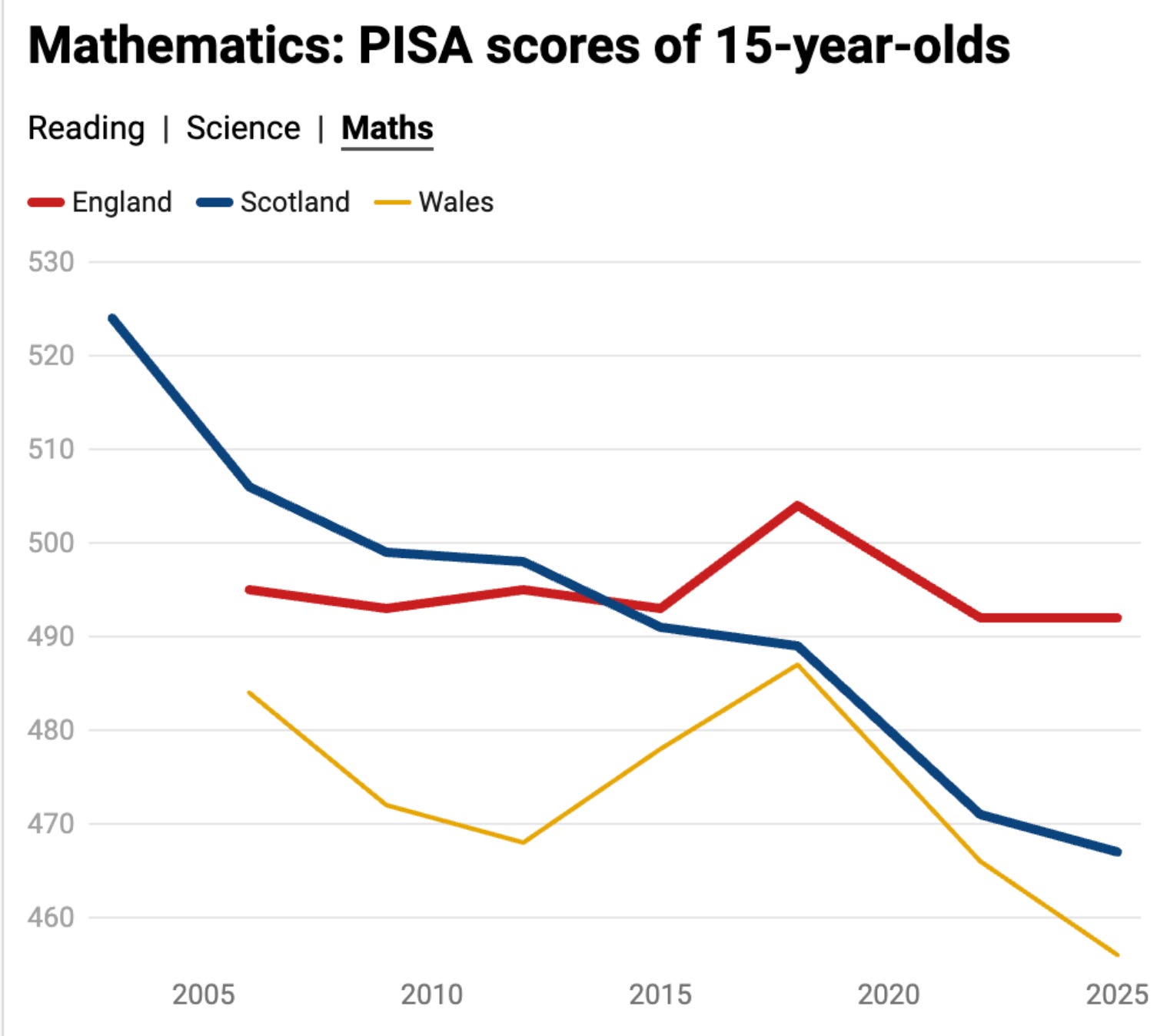
As John Burn-Murdoch points out, this same story has played out again and again, across Europe and within the US, where Republican-run, poverty-stricken Mississippi now out-performs Democrat-run, wealthy California. The knee-jerk opposition to rigour goes hand-in-hand with a fatal attraction to vague, modish, evidence-free ideas connected to wider social concerns - equity, child-centred learning, twenty-first century skills, critical thinking, whole-child development, and so on. Politicians and educationalists who advocate for such ideas always insist that academic excellence need not suffer as a result. Yet whenever they get their hands on the levers of education policy, that is the price which always, always gets paid. The biggest part of the cost is borne by the most disadvantaged children.
I just don’t believe, as many of the left seem to, that discipline, measurement, and academic ambition are somehow antithetical to social justice or the human spirit. The primary school which my children attended (my youngest graduated from it this year) is part of an academy chain in one of London’s poorest boroughs. It is non-selective and socially mixed on almost every dimension. It puts great emphasis on educational standards, and on good behaviour, and does very well in the rankings. When we were choosing, I remember some middle class parents in our cohort being wary of all this. Surely there should be more emphasis on play and creativity? Isn’t this school just an exam factory?
Well, it proved to be an amazing place. The classrooms were well-behaved which meant children actually learned stuff in lessons - and we knew that because they were tested a lot. The teachers were uniformly committed to tracking the progress of each child in detail, and pushing them as far as possible at every stage, no matter where that child started from. They also liked the kids; they took delight in them. Without getting sentimental about it, lest I ruin my reputation as the hard man of Substack, the school was full of love and laughter and fun. Its rigour was an expression of care.
I don’t think Hannah-Jones was wrong to consider criteria other than academic results when choosing a school for her daughter. Yes, schools should contribute to a fair and prosperous society. Yes, they should be places where kids feel happy, secure, and stimulated; where they can develop as people and express themselves. But these wider goals rely on many other factors outside a school’s control. The one thing we can and should ask of a school is that its charges leave it having been well educated in maths, reading, science and the humanities. That’s a big enough, tough enough job by itself, isn’t it? Even if we do know how to do it.
Please share this piece, which is free to read. After the jump: a Rattle Bag of goodies for paid subscribers. The Ruffian relies entirely on paid subscriptions. If you haven’t yet signed up for one, please consider doing so; it’s easy to and excellent value. Look out for a new episode of The Ruffian’s podcast, coming soon…
