



Catch-up service:
Pod: Cass Sunstein on the politics of the Beatles
Pain Is a Mind Game
Who The Hell Is Wesley Streeting?
Thinking By Hand
How To Save Centrism
What the Fuck Are We Talking About When We Talk about Love?
On Wednesday 17 June, my choir will be performing a selection of operatic classics, with some stellar soloists. It’s going to be a brilliant night, full of huge tunes and amazing singing (not me). Tickets are available here. It’s at Cadogan Hall in Chelsea. Come along!
This week: two funny stories about AI and writing, plus a juicy Rattle Bag including notes on maybe the best gig I’ve ever been to.
Having posted on it recently, I wasn’t going to return to the topic of AI and writing for a while. But this week has delivered a pair of stories so juicy that it’s impossible not to comment on them. First up: a prestigious literary prize was awarded to a story that was almost certainly generated by ChatGPT. (As far as I can work out this story was broken by friend-of-The-Ruffian Nabeel Qureshi, on his X account.)
The story is called The Serpent In The Grove, by Jamir Nazir. It was awarded a Commonwealth Short Story Prize and published in Granta. The award dispenses five prizes to five different Commonwealth regions; Nazir, or “Nazir”, is the winner for the Caribbean region.
The Serpent In The Grove is set in an enchanted farmhouse (of course it is) and concerns a troubled marriage. You can read the whole thing, but here’s how it starts:
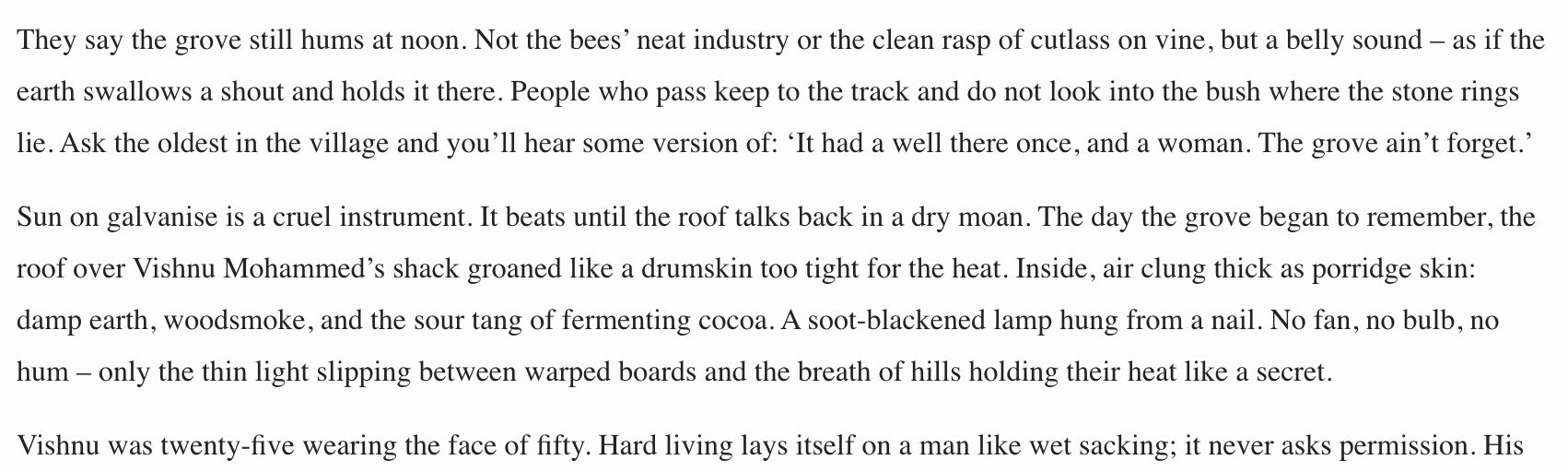
How do people know it’s AI-generated? They don’t know for certain, not yet anyway. But LLM prose has a certain flavour, and boy is it powerful here. This story is full of its stylistic and syntactical tics: weird metaphors which make no actual sense (“the breath of hills holding their heat like a secret”; many “not x, but y” sentence structures; over-use of certain words like “hums” and “quiet”.1 The entirely vacuous solemnity. The sense of someone, or something, straining to sound deep without having anything to say.
The grove ain’t forget.
Of course, all these things can be true of human-generated literary fiction, and none are infallible markers of LLM writing. But when they’re brought together like this, the flavour is unmistakable. Consider also that the only current internet presence of the author is a LinkedIn profile on which every post is clearly written with AI.

The AI-detection service Pangram deems The Serpent In The Grove to be 100% AI-generated. I sometimes think these mini-scandals are cunningly planned PR campaigns for Pangram; they certainly make the most of them. After this one broke, they ran all of the Commonwealth Prize’s winning stories since 2012 through the model. It found them all to be human generated, except for one in 2025 and three in 2026, of which Nazir’s is one.2
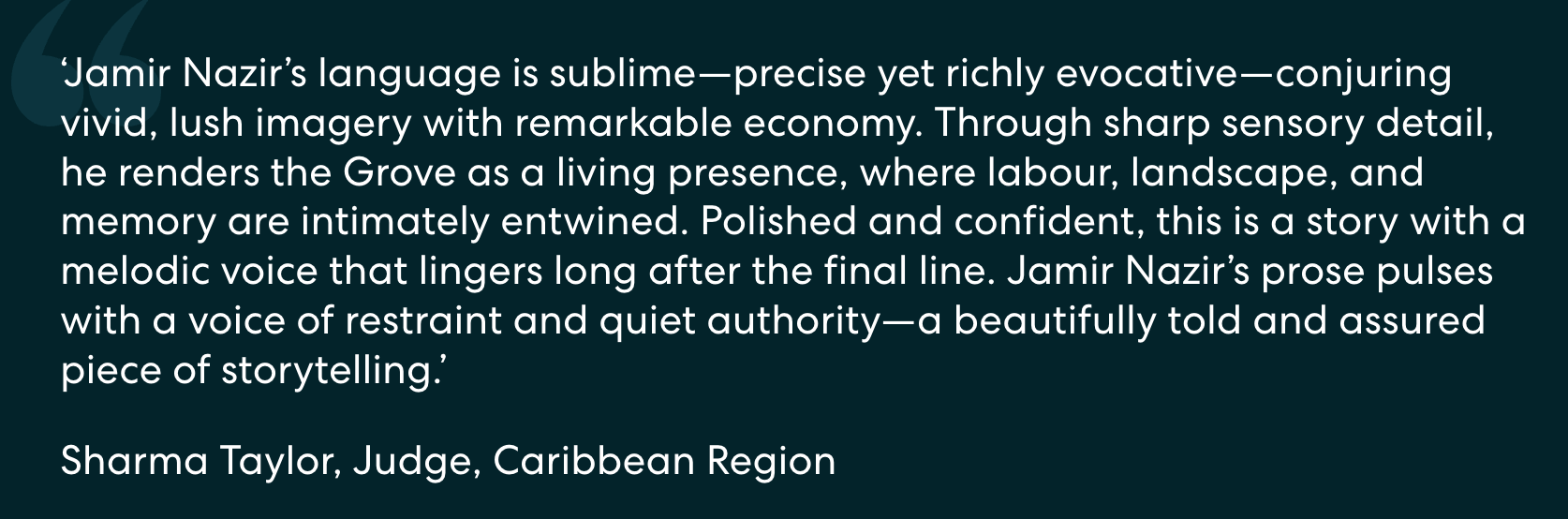
The response from the publisher of Granta, Sigrid Rausing, has essentially been to shrug and say, “Who knows?”
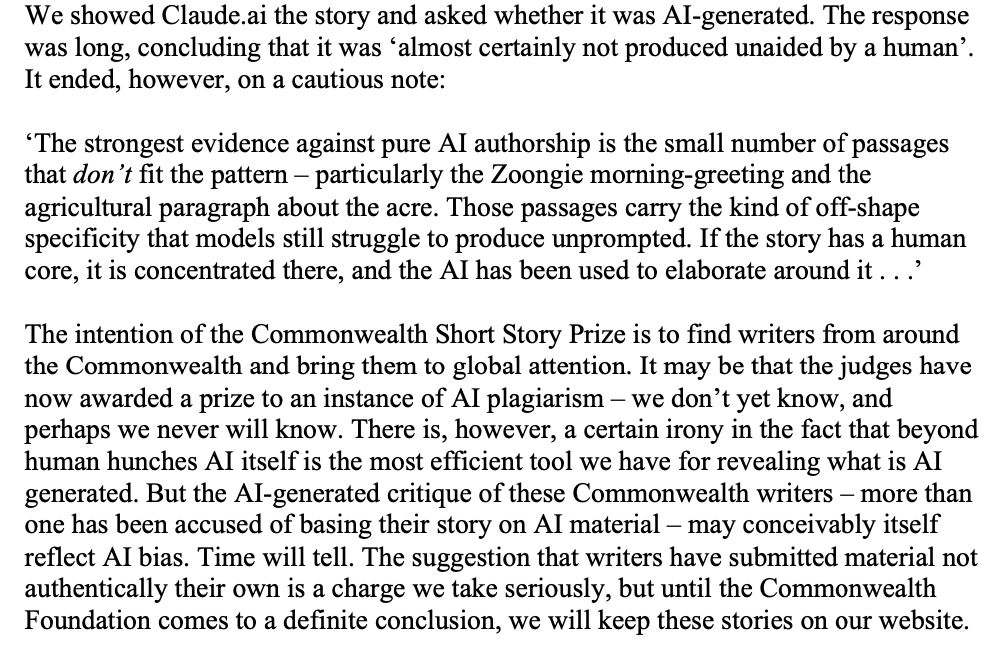
We asked Claude, it wasn’t sure, so whatareyagunnado.3 Anyway maybe it’s racism. A separate statement, this one from the Commonwealth Foundation, said, confusingly, that they would never feed stories to an AI model because then the evil AI would steal the content. Sam Leith, literary editor of The Spectator, agrees with Rausing. Rausing is one of our greatest philanthropists and Leith one of our best critics. I find their attitudes bewilderingly passive.
In the absence of evidence to the contrary, it’s reasonable to assume the story is AI-generated based on reading alone. The Pangram analysis is confirmatory evidence. But a little due diligence would have worked wonders here. Have any of the prize administrators actually talked to Nazir? Have they tried to track down the nameless “books published and others forthcoming” referred to in the capsule biography he has provided for them? I am sure the prize runs on a shoestring but even so, none of this requires much effort. Behind the AI’s output is a real person, a dab hand at prompting. Somebody is getting paid the prize money. The point is not to engage in a witchhunt, but to do justice to all the authors who went to the trouble of writing their own story.
I’ve been wondering why the prize administrators and judges are so slow to pick up on AI-inflected prose, whereas tech people can see it right away (especially those tech people who, like Nabeel, are voracious readers of literary fiction). I think it’s because literary people don’t spend much time reading LLM-generated writing. They just don’t use AI very much. The literary world has a fierce hostility to this technology, rooted in the fear that it’s about to destroy their livelihoods. If they used it more (but not to do their writing for them!) they would have better intuitions for what is AI writing and what isn’t.
They would also know that just asking Claude for a view isn’t enough, since the general models tend to equivocate on such questions and to be sensitive to the prompt (if they sense you want Answer A, that’s where they’ll lean). They would know that if you’re going to consult with AI, it’s much better to use a specialist model, trained specifically for this task.
Pangram works by taking millions of examples of human writing and generating an AI version of each one - a ‘synthetic mirror’. To distinguish between them the model is forced to focus on and recognise the stylistic fingerprints of machine writing. Perhaps it might be a useful exercise for writers to take a passage or scene from a favourite novel and prompt an LLM to do a version of it. They’ll soon get to know that distinctive flavour.
Right now, book people appear to be hostile to AI in general and lenient about its use in literary prizes. That seems like the wrong way around. Mishaps like this one should only remind us that literary fiction is relatively safe from AI. Indeed it has one of the biggest moats of any white collar endeavour. If fiction goes into terminal decline, it will be for other, broader reasons, and not because AIs can fake it. A story that isn’t written by a human has no purpose, and can only offer paltry satisfactions to a reader who knows this to be so.
Once people know a story or a book is AI-generated, they lose any interest they had in it (except perhaps, in these early days, some morbid fascination). The reader has to believe a story is written by a human in order to care about it. Yes, The Serpent In The Grove is terrible writing and shouldn’t have won an award, and yes, much handcrafted fiction is bad. But all these questions of quality are subordinate to that axiom. An AI-generated story simply can’t be ‘good’ in any sense but the most superficial.
It’s the mathematicians I feel sorry for.
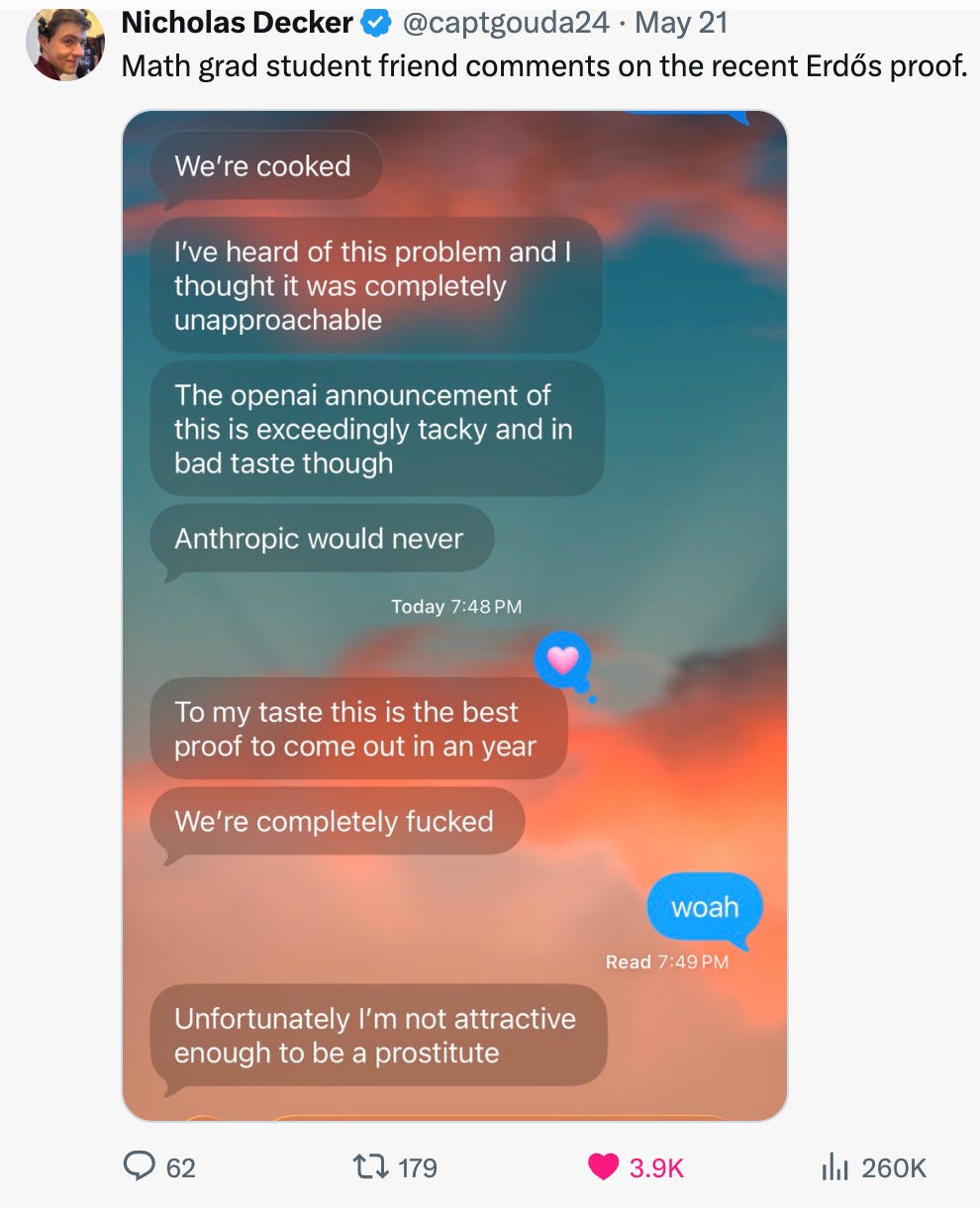
Right, on to the second screw-up of the week. This one is even funnier.
