


Catch-up service:
Young Churchill
Dear Me, England
Anatomy of a ‘F*ck You’
Happy John and Paul Day
Notes on Acquired Taste
Notes on Cannes
Greetings from France, where I’m on holiday. This week, something completely different (even more so than usual): the first work of fiction published by The Ruffian. It’s a joint production, co-authored by me and James Kanagasooriam, political analyst and friend of The Ruffian.
A little background on how it came about. James, as many of you will know, is one of this country’s leading pollsters, and if you’ve listened to his interviews with me or with Marina Hyde on The Rest Is Entertainment you’ll know that he has an extremely fertile and brilliant mind. For a few years now, as a side project, James has been working on a fictional narrative set in Britain in a dystopian near future: “Sortition”. It’s loosely inspired by trends he sees in the data, although to be clear it is very much a work of fiction and by no means a prediction or forecast.
James invited me to work on this project with him. He had a wonderfully detailed universe and a grand story arc but he wasn’t sure what to do with it all. I suggested we write a short story which functions almost like a chapter in the middle of this bigger story, giving readers just enough detail to want to know more. So here it is. James is publishing it on his Substack too. We hope you enjoy it.
1.
The beef is resting. The table is set. I am waiting for my family to assemble, perhaps for the last time. From our kitchen, I look west along the river towards the glass and steel of the City, obscuring Westminster. Down below, millions of Londoners are scurrying to wherever they feel safest, carrying their lives with them. The skies are awash with drone murmurations.
To be prepared is to win, or at least not to be humiliated. That is what my supervisor told me, at my first chambers. Over the years I found out how right he was, and not just at work. But that was then. That was when Britain was still a country and we were still a family. With the way things are now, it is so hard to know what one is preparing for.
Jack is late. Of course he is. Even his brother Peter would have had trouble making this appointment on time. London is clogged and chaotic because so many people left it until today to get to their new home[IL1] sector. A city in denial is finally coming to terms with the reality of sortition. Neighbours who have been squabbling for years have been forced to accept that they cannot and should not be living together anymore.
It is a relief, in a way. The endless handwringing over national divisions, the insistence that we have more in common with each other than that which divides us – it was always futile. Now it has stopped and we can move on to whatever we’re moving on to. It’s not just London, of course. The whole of Britain is like Europe after the Romans fell, a moving patchwork of criss-crossing tribes, each seeking the sanctuary of their own community. Maybe it’s like the Austrio-Hungarian empire after World War One. But somehow none of these grand historical analogies feel quite apt. There’s no dignity to the present; it all feels all breathless and ragged rather than momentous. There are forty-eight hours to go.
From the kitchen, I can hear Tom and Sophie together in his study. Arguing, teasing, imploring. That used to be my favourite music, when she was a teenager. Tom’s sonorous baritone duetting with Sophie’s graceful contralto, punctuated by peals of laughter. (It’s hard to pinpoint exactly when she became Daddy’s girl, but there are some contests – not many – I haven’t minded losing.) There isn’t any laughter today though. I can’t hear them distinctly enough to tell what they’re saying, but I can guess. They’re talking about the break-up: whose fault it is, whether it is temporary or permanent,what if anything can be salvaged from the ruins of a country that repelled every invader for a thousand years before turning on itself. Tom will be trying to persuade Sophie to join him in Aperta, although he is too clever to argue for it directly. He made that mistake with me. He is having to learn, as we are all having to learn, and relearn, that everyone is free to make their own choice. We are a family, but we’re all different.
Now, here they are, having paused their private colloquy to check in on me.
“Still no word from Jack and Peter, darling?” The moment Tom says this, my watch buzzes.
Soz coming soon. Fuckheads everywhere. Tell dad to stop texting me.
“The prodigal son reports his imminent arrival. I haven’t heard anything from Peter. The beef is perfectly happy to rest. Why don’t you open another bottle, Tom?”
“I don’t think Dad should drink too much before Jack and Peter get here,” says Sophie. “You’ll only end up screaming at each other.”
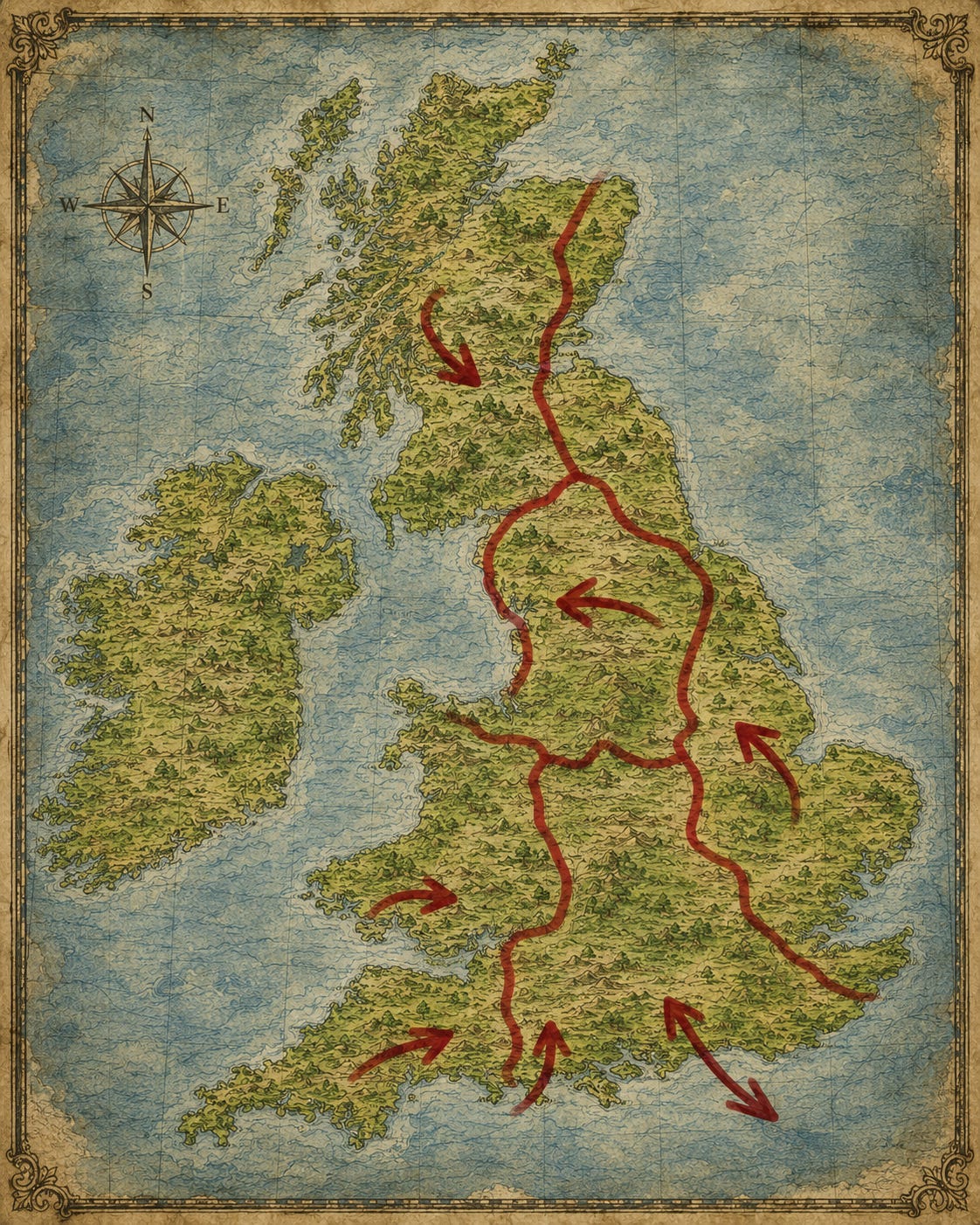
“Nonsense,” says Tom, crouching by the wine cabinet. Sophie goes over to the map on the wall. It shows Britain, or what was Britain, slashed into five different successor nations by Tom’s red marker pen, arrows darting and swooping around the country like trade winds.
Aperta, Mercia, Radex, The Arc, The Wildlands. A new set of home nations to replace the dysfunctional, and – as Tom would have it - entirely irrational set of arrangements we used to call Great Britain. Despite having been anticipated for so long, it is almost impossible to accept it’s happening, right now: Apertans evacuating the north and heading south-east in a convoy of Teslas to join their impeccably attired brothers and sisters at the centre of power; Mercians moving west and back in time, towards their determinedly un-diverse Betjemanian utopia, untroubled by modernity; Radexians hurtling out of Mercia and into their zone to construct a new society from ground-zero; Arcists converging on what remains of Cambridge and Oxford to build AGI and turn the flesh puppets into pets. Everyone else – everyone who doesn’t fit anywhere else – pouring into the Wildlands.
This will be no friendly “family of nations”. These are groups of people with objectively different values and attitudes who despise each other, and who will rely on strong border controls and mutual deterrence just to avoid further violence. Meanwhile, my family gathers here in Greenwich to say our goodbyes, rather more amicably, I hope. The Moncks’ last lunch! It sounds so melodramatic. But it might well be true.
“Mummy. Have you heard from Peter?” I can only see Sophie’s back from here but something about the position of her head tells me she is tense. I try not to show her that I am too. I’m thinking about the time Peter broke his leg playing rugby when he was thirteen – how, in the ambulance, he was determined to convince me that he would be OK; the injured boy consoling his mother.
“No, love, but Pete will be fine.”
“I’m sure he’s on his way,” says Tom. “It’s impossible to get a phone signal at the moment. Now, white or red? White, I think.”
Sophie comes towards me, then stops, holds on to the table and sits down, as if suddenly faint. “I wish none of this was happening,” she whispers into the white porcelain bowl before her.
“Well, as Fleetwood used to say to me, about once a week, we are where we are,” says Tom, setting a glass of wine before his daughter. “The egg is broken and there is no point trying to unbreak it. All we can do is try and make a delicious, feather-light omelette. Or five.”
“Shut up Dad,” says Sophie. She says it softly, though I am slightly taken aback. Tom, apparently unperturbed, rolls on, adopting his public voice: eminently confident, verging on pompous. “Look, nobody fought harder than me to keep this country together. I hardly need to tell you that.” He sips from his glass, as if about to embark on a best man’s speech, or a debate at the Oxford Union.
“I am coming to terms with it, however,” he says. “I loved my country but I never had some mystical attachment to ye olde Britain. It wasn’t a fucking oak tree. It was a man-made construction, a grudging arrangement of economic and social interests which formed and reformed according to contingent conditions. It was all about England, and really all about London, or certain parts of it. We forced Ireland to join us, and then it forced its way out. Scotland came along for the ride then jumped off into a ditch. Wales always wanted to be left alone. See also Cornwall. Why should we pretend it was ever one big happy family?”
His voice, so often used to command whatever room he is in, washes over us. “Those arrangements were accidents of geography and history. At least the current re-ordering is based on ideas, attitudes, data. What we’re seeing now is a perfectly rational response to the hard truth that what was, at best, a marriage of economic and constitutional convenience was no longer based on kinship and fellow feeling, if it ever was. The new Home Nations are still bound intimately together, but in a more sustainable way. We will still have diplomatic relations, jurisdictional commonalities. We will do business with one another. It’s just that it makes sense for us to have separate bedrooms now. It’s an amicable separation. That’s all it is.” He sits down, satisfied that there is nothing more to be said.
“What are you talking about Dad?” says Sophie, ignoring the glass of wine Tom placed in front of her. “You don’t believe this. The metaphor doesn’t even work. It’s not two people going their different ways. It’s one person splitting into five. And it’s not amicable. It’s this person - these five little people - scratching each other’s eyes out. Wait, that doesn’t work either. Oh fuck. Mum, can I smoke?”
“If you must.”
“I must.”
The intercom sounds and I look at my phone. Jack. Even through the screen, I can see how dilated his pupils are.
“Never remember what floor you’re on.”
“Twenty-eight,” I say, buzzing him in.
“It’s not as if we’ve been here long, is it?” says Tom, shaking his head. “Only ten years. Tell the concierge to lock him in the basement, Penny. Joke.”
2.
We are silent for the full two minutes that it takes Jack to reach our front door. It’s only a minute’s journey up to the flat, so I assume Jack has used the time to pop some chewing gum in his mouth and spray on some deodorant. He tumbles in, gives me a smelly hug, claps his father on the shoulders, kisses Sophie. “So, my beloved fucktards. We are gathered here today to deal with the almighty fuck-up that Daddy and dear departed Fleetwood made of this country. Are we not?”
“Will you have some wine, Jack?” says Tom, glassily cool. “We have a rather good Burgundy open.”
“Yes please, Daddy,” says Jack brightly. “No way I can get through this sober.”
“Nor would I expect you to.”
Tom’s phone rattles on the table. He glances at me. “Let me just make this call. They need me to speak to a woman from CNN.” As Tom leaves the room, he breaks into a cheesy American accent. “Sir, will you explain to our brain-dead viewers in Kentucky what sortition is? Real slow now. And is the King of England still King?”
Jack lights a cigarette, seeming to calm down little. “Good question actually.”
“He’s the King of Aperta,” I remind him. “Whether he quite knows what that is, is another question.” Tom shouts back at us from the study: “I tried to sell the split to the Palace as an imperial expansion. Look, you’ll have even more nations to rule! Didn’t quite buy it.” Then he slips into this Today programme voice and shuts the door.
“Peter not here yet?” asks Jack.
“No and we’re not entirely sure where he is just at the moment,” I say, trying not to betray my nerves. “We’ve had no messages but it’s very difficult out there...”
“He’ll find his way here. If anyone can navigate the balaclavas on bikes and the fascists at border control, it’s Pete. Super-Pete.”
“How was your journey?” I ask, noticing his jiggering leg.
“Fucking shit and I hope you’re all bloody grateful I made the effort. First of all I had to bribe some fat cunt at the makeshift passport office to get my Radex papers expedited. Then I had to stand in line with about ten thousand Apertans to get in here; then deal with the slimy fash twat at the border asking me how long I’d be in for and where I was staying. When I said I’d be staying with Tom Monck and spelt out our name, his little pasty face nearly melted with panic. Once I was inside it was actually worse because people are literally killing each other to get a Waymo. I had to walk for three hours through fucking carnage. Only upside is that if you want to score drugs it’s the easiest it’s ever been because the police are all manning the border.”
We can hear the soothing rumble of Tom’s voice from the study. He is doubtless assuring his interviewer that Great Britain is simply undergoing a little rearrangement. A tidying up, a Spring clean, a software update. Nothing to worry about. The silky cadences, the avuncular chuckle; a voice that has reassured anxious Prime Ministers, soothed presidents, and calmed voters. Tom is - or was - a master of making everyone feel that there is a plan, that all will be well, that it’s in hand. It is, isn’t it?
“What’s your plan Soph?” says Jack. “I presume you’re staying in Aperta to help Daddy run what’s left of the country.”
Sophie stares at her bowl. She speaks softly. “That’s what Dad wants me to do. Yes.”
3.
Tom comes back into the room. “Right. That’s quite enough baby-talking the sodding Yanks. Let’s eat.”
“Shouldn’t we wait for Peter?” asks Sophie.
“I don’t think there’s much point in that, is there?” said Tom. He clears his throat. “What I mean is, we don’t know where the hell he is and he hasn’t deigned to inform us. So let’s get on with it. I’m sure there’ll will be leftovers.”
I place the joint in the middle of the table, turning the handle of the knife towards Tom. He begins carving with his usual dexterity. As he slices through the meat he talks about sortition.
“So many people are treating this as if it’s some natural disaster that has hit the country, a meteor. In truth it’s a choice. Everyone has been willing it for years, decades. The fact is that people are finally getting what they want and some of them don’t like it. Are you sure you won’t have more beef, Soph? It is sublime. Mummy has created another masterpiece. I tried harder than anyone to avert and delay this day. You know that. But now it’s here, we all have to accept that there is no going back.” He serves each of us in turn, allocating the requisite amount of meat, potatoes, green beans.
“So we must all plan accordingly. Jack, are you really going to stare at your phone for the whole lunch? It’s not the end of the world. It’s the end of a country, at least the country we knew. But that is OK. History is always unfolding, never static. Sortition is the right thing to do, even if we – I - wish it hadn’t come to this. And when you finally do the right thing, the difficult thing, the thing you’ve striven to prevent or delay, then things tend to get better. Isn’t that so, Penny?” He flashes a smile at me.
In order to ignore him I proffer a jug of gravy to Jack, who sploshes it over his potatoes without looking up from his phone. “Oh my fucking god,” he says. “There’s a bloodbath at the crossing point between Mercia and Radex. Bunch of Radexians tried to extract all the people who failed value cleansing. Mercians intercepted them and opened fire. Killed about twenty of them on the spot, captured a dozen more. Now threatening a public caning. Whoo boy they don’t fuck around, those Mercians. At least you know where they stand.
Sophie’s eyes widen in horror. “Jesus, that’s horrific. Dad, what are we going to do about this? Can we send in the police? The army?” I do wonder if she has been paying attention. Tom doesn’t answer at first. After ostentatiously surveying the table to ensure that everyone has a full plate, he sits down. “That’s not how it works anymore, Sophie. As you know,” he says, quietly. “We can certainly bring it up at the inaugural UK5 meeting. But it’s not our job to police other jurisdictions.” He raises a glass and addresses the table: “Here’s to a brighter future for our country after sortition. Living apart will enable us to live together.”
“Fuck that,” says Jack, “Why are you talking like a fucking Soviet apparatchik? Everyone knows we’re in for twenty years of value cleansing, black markets, border skirmishes, endless law suits, and probably a foreign invasion. You yourself said this would be a disaster right up until five minutes ago. Right up until it became clear you’d basically get your own little country to run. The Lee Kuan Yew of Aperta. Then all of a sudden you became the face of sortition – Mr “Sort Or Die”. You were in every TV studio, on every screen, selling the fuck out of it. You made sure all your favourite think tanks were funded and spreading the propaganda. You made sure the right officials were brought round or bought off.”
Tom is caught off guard by Jack’s (surprisingly acute) summary of the situation. I feel moved to intervene. “Please Jack. Try and be nice. Just for today. We may not be seeing much of each other for a while.”
Tom does not return Jack’s vitriol. Instead, he swallows some roast potato and embarks on another speech. “However divided we became, I believed we could work through our differences. I believed we could muddle along. It’s the British way, after all; we’ve always been a nation of tribes who ultimately preferred trading to fighting. But when the facts change, I change my mind. The cracks have been widening the whole of this century. Every time we were hit by a crisis – the financial crisis, Brexit, Covid, the triple-election year– the divisions went deeper. Each time, everyone blamed the event itself, rather than seeing that the events merely revealed what was already there.
“None of us wanted to believe the truth. We wanted to believe we were, underneath it all, one people. But then we had riots in London every weekend for five years straight. Across the country, every local government building firebombed, officials terrorised. Parliament like a circular firing squad, everybody screaming for change, nobody able to agree on what to change. Stalemate for twenty years, while the country got steadily poorer and angrier.
“Fleetwood was the last man with the ability to bring everyone together and move forward as a country. But Joe was Joe, and Joe is gone. There’s nobody else like him. And I believe even Joe couldn’t have held things together for much longer. I think he knew that, too, even if he didn’t say so.”
“I don’t recall you relaying that to us when he was alive,” said Jack. Tom says nothing in response, although I spot a wrinkle of contempt passing across his face. He carries on.
“The data has been staring us in the face for thirty years. There are four, maybe five different peoples in this land, each of them with different ideas about right and wrong, about crime and punishment, about immigration, about technology. Each of them seething with resentment and contempt for the other groups. Each group convinced that they are the victims. It might be OK if already had their own provinces; the trouble is that they are mixed up across the country, side by side with people they hate. You cannot run a polity anywhere with divisions as raw as that. Liberal democracy is designed to accommodate difference, but it has a tendency to sharpen and exacerbate those differences until they become too much to bear.”
“Oh that’s deep, father,” says Jack, applauding. “So fucking insightful. Sophie – write that down for your book.”
“Shut up Jack,” says Sophie, quietly but firmly. Jack’s head jerks back in surprise. He is silenced for the time being. Tom gulps down a big mouthful of wine.
“The only solution, then, was to divide the country into nations and London into zones, and let everyone sort themselves accordingly. Let everyone seek their own tribe, and yes, let them expel those who do not belong. Now we have an arrangement I believe everyone can live with. Apertans can pursue carbon neutrality and make it illegal not to attend university, as it should be. Mercia can bring back public hanging and make everyone go to church on Sunday. The spectrummy dweebs in Arc can use genetic selection to create high-IQ nerd babies. Radex can try and implement its mad demographic points system and communist economy - Jack here will have to prove his commitment to “radical equality” or risk getting value cleansed. The rabble in the Wildlands can – do whatever deranged hippies do when left to their own devices.”
Jack looks at Sophie, who keeps her head down. “Didn’t you have a boyfriend in the Wildlands?”
Sophie gives him a look, but answers calmly. “I’ve got a few friends headed for the Wildlands, yes. It’s not as crazy as Dad makes out.”
Tom drops his cutlery and regards his daughter incredulously. “What on earth are your friends thinking? The Wildlands people hate anything to do with modern life. They hate technology. They hate all laws. It will be like living with the Amish! I hear don’t they even wear shoes because they think shoes corrupt natural posture. I’d be surprised if they believe in hospitals. Hope you don’t ever give birth in the Wildlands. No fucking epidural there.”
“They’re good people, Dad,” says Sophie. “They’re the only ones who don’t judge you on who you are or what you believe. They’re they only ones who relish difference. They’re the only ones who don’t value cleanse. They seek a return to life before big tech, billionaires and social media warped our brains. They read books. You’re judged on what you do rather than what you believe. If you’re human, you’re welcome.”
Tom just stares at her for a few seconds, for once at a loss for words. His phone buzzes. From where I’m sitting, I can see it’s from ‘H’. He leaps to his feet. “I’m sorry, I must just take this. I’ll be five minutes.” We eat in silence for a few minutes. Unusually, Tom’s voice does not carry from his study. Then Jack says to Sophie: “Where do you think Peter really is?”
Sophie wrinkles her brow. “What do you mean “really is”? He’s trying to get here. It’s chaos out there. You know that. Probably stuck at some checkpoint.”
“Oh come on,” says Jack. “Peter doesn’t miss Sunday lunch. If I can get here on time, he definitely can. He’d have had the whole journey planned out weeks ago. He’d have prepped his papers, packed his creatine and his energy gels, designed his hydration schedule, planned for about fifty thousand contingencies. It’s Peter, for fuck’s sake. Pete could have planned the fucking D-Day Landings. If he’s not here, it’s for a reason.”
Now I speak, softly. “Peter was asking questions.”
Sophie and Jack, who have been locked into each other, now turn towards me in unison, two pairs of cartoon eyes opening wide.
“Questions? What questions?” asks Jack.
“About the funding for the Sortition Foundation. Peter pulled on a thread and kept pulling. Until – “
Tom barrels back into the room and resumes his seat.
“Sorry about that! Last time I promise. In fact, let me switch this bloody thing off. Now, would anyone like another slice?”
Sophie is still staring at me.
4.
“Nobody wants any more beef, Dad,” says Jack. “Everyone is feeling a bit sick. Probably all the fucking bullshit.”
Tom ignores Jack. He glances at the empty place setting for Peter. “He’ll be on his way,” he says, in his most pacifying voice. “You know Peter. He’s the most resourceful of any of us. ”Soph,” he says, as he cuts himself a slice of beef. “How was your concert in St Martins last month? Didn’t you play Vivaldi?”
Tom’s attempt to restore normality isn’t working. Sophie does not answer him. She stares at her half-eaten plate of food. Tom looks at her, then at me, with an uneasy smile on his face that betrays something I have only seen once or twice in thirty years of marriage: the creeping sense of being caught in a lie, without yet being sure who’s bluffing.
Jack says, “Where is Peter, Dad?”
Tom looks incredulous. “How am I supposed to know? I don’t have a tag on him. He’ll be here before long. Look, may I suggest we move the conversation on? Obsessing over Peter’s whereabouts won’t make him get here any more quickly.”
“Don’t fucking lie to us, Dad,” says Sophie. Now it’s my turn to look shocked – Sophie doesn’t swear. I’ve never heard her speak like that to Tom. I suppress an ancient impulse to tell her off. Tom looks at me, seeking explanation or maybe protection. I can’t meet his eye.
“Have you all gone mad?” says Tom, turning his eyes on each of us in turn. His face is red. “Did you all drop some acid when I was out of the room? What is this?”
“What did Peter find about you that you didn’t like, Dad?” asks Sophie. Suddenly, she doesn’t seem like my daughter anymore - she doesn’t seem like a girl. Her eyes are boring into her father’s face. Tom can tell from my averted gaze that I am somehow complicit with Sophie. He stares at me while he talks to the others. “Look, I have no idea what your mother has been telling you but…”
Sophie stands up. She speaks calmly. “Dad, you can’t sweet talk your way out of everything. You’ve been playing politics with the country and now with your own family. You love to talk about democracy and happy families but the truth is that if someone is saying something inconvenient to you, you always find a way to shut them up. You thought you could shut Peter up. But Peter didn’t –
“Soph,” says Jack, looking sheepish. “Going a bit far now. Dad’s got a tough job. His work is important. Peter was always –“
“Always what? The one asking uncomfortable questions?” says Sophie, turning on her brother. “Always making a nuisance of himself? Or maybe he’s just more principled than you? Maybe he actually believes in something?”
Jack’s face goes purple.
“Sophie,” I say. “Don’t be horrible.”
“It’s OK, Mum,” says Jack. “I can stand up for myself. Big boy now.” He swigs wine from his glass and looks on the verge of tears.
Sophie turns back to Tom. “Peter found connections to foreign powers, didn’t he? To Henry. And that was enough for you to…”
Silence. Tom has been holding his head in his hands and rubbing his eyes with his fingers. He suddenly looks weary and fed-up, although I can’t tell if he really is. His hair is dishevelled. There are bags under his eyes. When he speaks it is almost in a whisper.
“You don’t know what you are talking about. You don’t have the context and you don’t have the burden. The job I do comes with terrible choices. I made a choice. Peter was going to ruin everything we’d been working towards for years. He was going to destroy our last chance to save this country.”
“You’re not saving this country, Dad, you’re slicing it up!” says Sophie. “And keeping the most powerful bits for yourself! The army, the civil service, the intelligence services.” Her body shaking, she makes a visible effort to compose herself. “Where is Peter? Tell the truth.”
Tom is silent. He pushes his plate aside.
“You handed him to them, didn’t you?” says Sophie. “Your own son?”
Tom says, with a terrible calm finality, “I made a choice.”
“You broke up Britain, and now you’re breaking up this family,” says Sophie. “All so that you can feel important.” She looks at me. “And you’re letting him.”
“Sophie,” I say. “Dad has had to do some awful things in the course of his work. Perhaps he has made mistakes. But we are a family and Dad is the only man who can keep the country together. I’m sure Peter is safe and being looked after, wherever he is. Isn’t he, Tom?”
Tom looks at me, surprised, and nods.
“There is no family,” says Sophie, with disgust in her voice. “You’ve destroyed it. I’m going to find Peter. And I’m going to fight Apertan dominance. But I’m never going to pretend this is a family anymore.” With that, she leaves. Jack gets up from the table, looking dazed and unsteady on his feet. “Dad, I-”
“Oh fuck off, you little shit. Fuck off.” Says Tom.
Jack shambles out in tears. The door slams for a second time.
Now it’s just Tom and I.
We remain at the table. “Thank you,” he says, without looking at me.
“That’s the last time I do that for you,” I say. And then I tell him what I know.
But please give it a happy ending ! I can’t take much more gloom
Fabulous. When do we get the full story, please?